
The relevant period
AWE is always measured over a relevant period ending on a normal payday. For Statutory Maternity Pay it ends on the last normal payday falling in or before the qualifying week, the 15th week before the expected week of childbirth [1]. For Statutory Paternity Pay it ends on the last normal payday on or before the Saturday of the qualifying or matching week, and for Statutory Adoption Pay on the last normal payday in or before the matching week. In every case the period starts the day after the last normal payday falling at least eight weeks earlier [2].
For Statutory Sick Pay, the period ends on the last normal payday before the first complete day of sickness and starts the day after the normal payday at least eight weeks before that [3].
How AWE is calculated
- Which earnings count: everything paid on a payday inside the period on which Class 1 National Insurance is due, or would be due if it were high enough, even if it relates to work outside the period, such as holiday pay paid in advance. Blank weeks count as zero pay [4].
- Weekly paid: add up the earnings and divide by the number of weeks in the period.
- Monthly paid: add up the earnings, divide by the number of months, multiply by 12 and divide by 52. The result is not rounded to whole pence [3].
The LEL test
For SMP, SPP, SAP and ShPP, AWE must not fall below the National Insurance lower earnings limit in force at the end of the qualifying week [1], which is £129 a week for 2026-27. SSP has had no earnings test since 6 April 2026: AWE only decides whether the employee gets 80% of AWE or the flat rate of £123.25, whichever is lower [5].
Worked example
An employee paid £2,600 on each of two monthly paydays in the relevant period has total earnings of £5,200. Divided by 2, multiplied by 12 and divided by 52, AWE is £600.00, above the LEL. SMP is then 90% of AWE, £540.00 a week, for the first six weeks, then £194.32 a week, because the flat rate is lower than 90% of AWE [6].
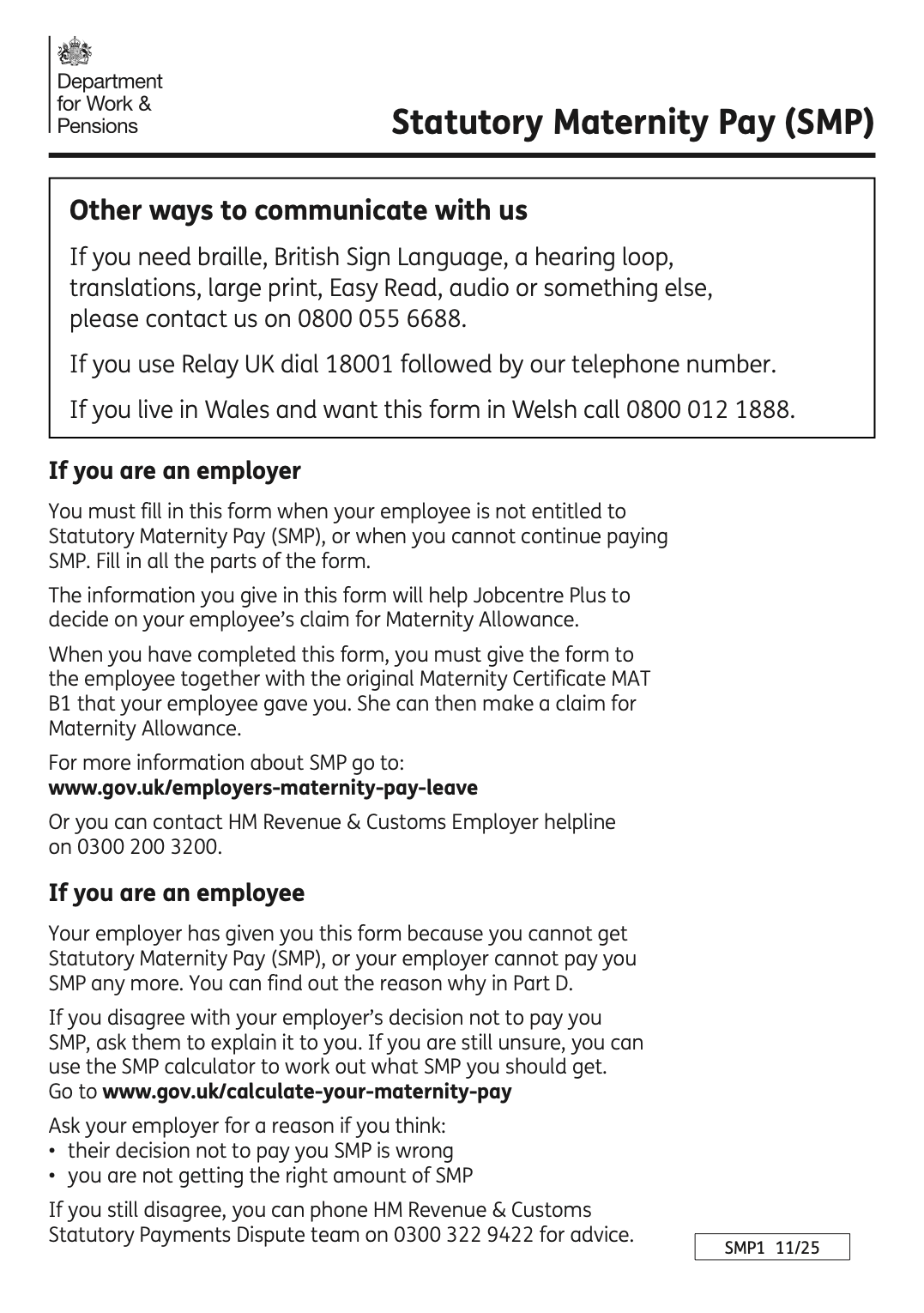
The SMP1 form when AWE is too low
When an employee is not entitled to Statutory Maternity Pay, the employer fills in form SMP1, version SMP1 11/25, and gives it to her with her MAT B1, so that Jobcentre Plus can decide her claim for Maternity Allowance [7].
Part C: the dates behind the AWE
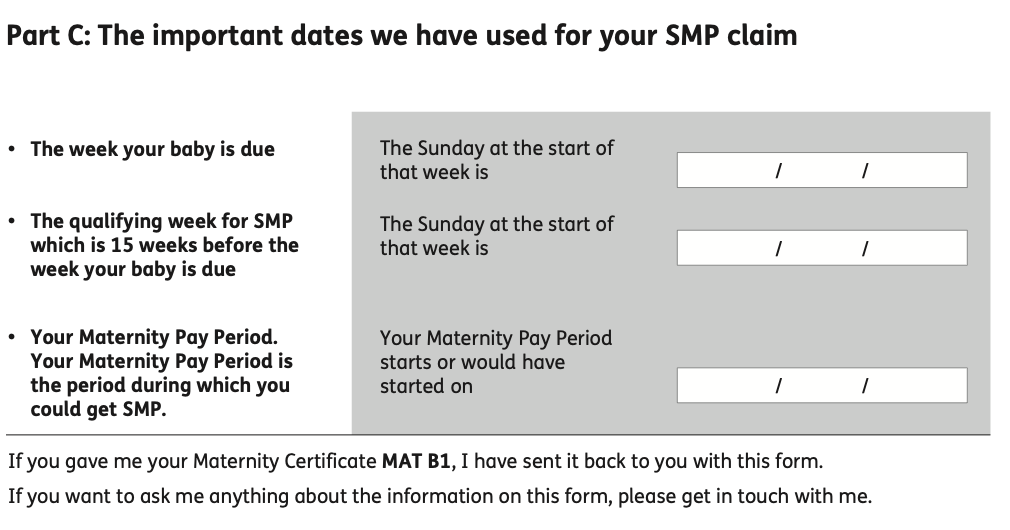
The week the baby is due. Given as the Sunday at the start of that week.
The qualifying week. 15 weeks before the week the baby is due. The relevant period for AWE is fixed by reference to this week, as explained above.
The Maternity Pay Period. The date it started or would have started.
Part D: average weekly earnings not high enough
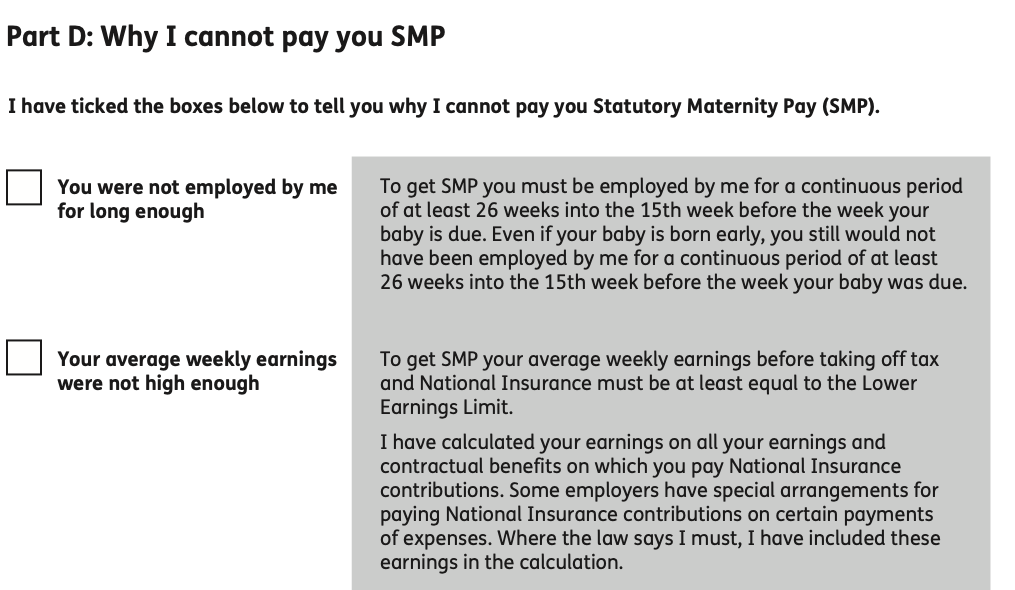
Not employed long enough. 26 weeks of continuous employment into the qualifying week.
Average weekly earnings not high enough. AWE before tax and National Insurance must be at least equal to the lower earnings limit. The employer confirms the calculation covers all earnings and contractual benefits on which National Insurance is paid.
Common mistakes
- Using contractual salary instead of the earnings actually paid in the period.
- Leaving out a bonus or backdated pay paid on a payday inside the period.
- Measuring to the start of leave instead of to the qualifying week.
- Applying the old LEL test to SSP.