
How the lower earnings limit works
Class 1 National Insurance has several thresholds. Below the LEL, earnings do not count towards the employee's National Insurance record. Between the LEL and the primary threshold, the employee pays no National Insurance but gets the benefits of paying [1]: contributions are treated as paid, to protect the record, for an employee earning from £129 to £242 a week from one job [2].
That protection matters because entitlement to the State Pension is built from qualifying years, and at least 10 are needed to get any new State Pension [3]. A low-paid employee whose pay sits at or just above the LEL still builds those years without paying contributions.
2026-27 values
| Pay period | LEL |
|---|---|
| Weekly | £129 |
| Fortnightly | £258 |
| Four-weekly | £516 |
| Monthly | £559 |
| Quarterly | £1,677 |
| Annual | £6,708 |
The weekly, monthly and annual figures are published in HMRC's employer rates for 2026-27 [4].
The link with statutory pay
For Statutory Maternity Pay, the employee's average weekly earnings in the relevant period must not fall below the LEL in force at the end of the qualifying week [5]. Statutory Paternity Pay and Statutory Adoption Pay use the same test: average earnings of at least £129 a week [7] [8]. An employee who misses it gets no statutory payment from the employer.
Statutory Sick Pay no longer has this test. From 6 April 2026, SSP is available to all eligible employees regardless of their earnings, paid at 80% of average weekly earnings or £123.25 a week, whichever is lower [6].
The LEL on form SMP1
When average weekly earnings fall below the LEL, the employer records it on form SMP1, version SMP1 11/25, which the employee needs to claim Maternity Allowance [10]. Part D has a box for exactly this reason.
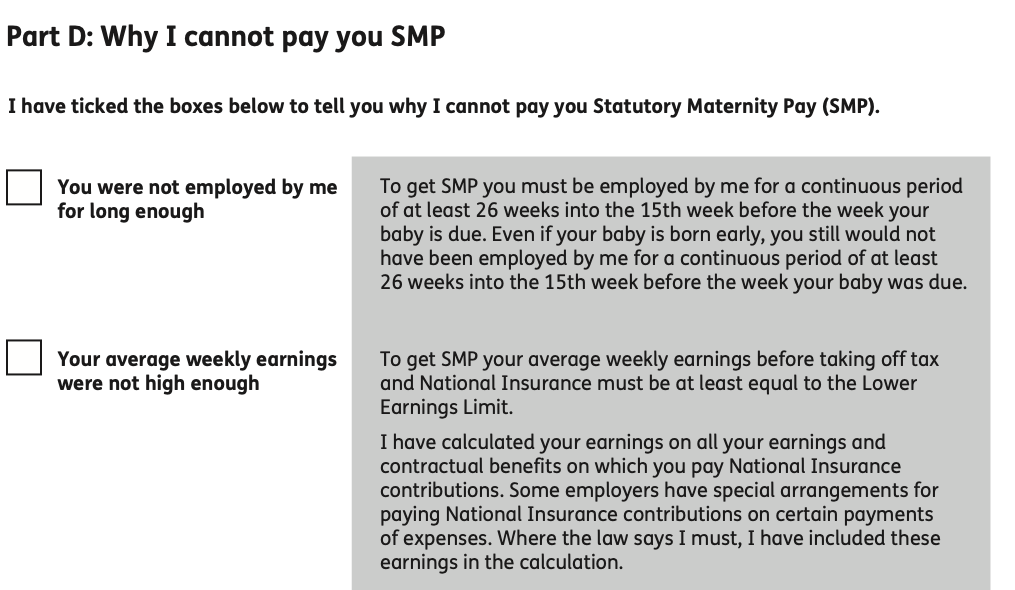
Average weekly earnings not high enough. AWE before tax and National Insurance must be at least equal to the lower earnings limit.
What the employer must do
- Use the LEL for the employee's pay period, not a weekly figure scaled up.
- Report earnings at and above the LEL on the Full Payment Submission, including the band between the LEL and the primary threshold where no National Insurance is deducted, so that the earnings reach the employee's record [9].
- Test average weekly earnings against the LEL before paying SMP, SPP or SAP.
Common mistakes
- Mixing up the LEL and the primary threshold. National Insurance becomes payable at the primary threshold (£242 a week); the LEL is lower.
- Confusing the LEL with the pension lower limit. The auto-enrolment qualifying earnings lower limit is £6,240 a year, not the LEL of £6,708.
- Still applying an LEL test to SSP for absences that start on or after 6 April 2026.