
Work out Statutory Sick Pay
Day-one SSP under the 2026 rules: the lower of £123.25 or 80% of average weekly earnings.
Statutory Sick Pay runs for a maximum of 28 weeks at £123.25 a week for the 2026-27 tax year, and an employer who pays it cannot reclaim a penny of it from HMRC [3]. When that 28-week ceiling approaches, or when an employee never qualified in the first place, the employer has a legal duty to hand over one specific document: form SSP1 [1].
The SSP1 is the bridge between an employer's sick pay obligation and the state benefit system. It tells the employee, in writing, why Statutory Sick Pay has stopped or was never payable, and it gives the Department for Work and Pensions the information it needs to assess a claim for Employment and Support Allowance or Universal Credit [1].
Issuing it late, or not at all, leaves a sick employee unable to claim the benefit they are entitled to, and exposes the employer to an HMRC dispute. This article sets out exactly what the form is, the two scenarios that trigger it, the strict deadlines attached to each, and how the SSP1 connects to the benefits an employee moves on to next.
Key takeaways
- The SSP1 form is issued when an employee's Statutory Sick Pay is ending or when the employee does not qualify for it at all.
- When SSP ends unexpectedly, the form must reach the employee within 7 days of the payment stopping.
- When SSP is expected to run its full course, the form must be sent on or before the start of the 23rd week.
- An employee who does not qualify for SSP must receive form SSP1 within 7 days of their first day off sick.
- The form supports a claim for New Style Employment and Support Allowance or Universal Credit, neither of which the employer pays.
What the SSP1 form is
Form SSP1 is an HMRC document that an employer completes and gives to an employee when Statutory Sick Pay is not payable, either because it has run out or because the employee was never eligible [2]. It records the dates SSP was paid, the date it ends, and the reason payment has stopped, so the employee can pass the detail to the Department for Work and Pensions [1].
The form matters because Statutory Sick Pay is finite. It is payable for a maximum of 28 weeks in a single period of incapacity for work or a series of linked periods, after which the employer's liability ends entirely [5]. At that point the employee may still be too unwell to return, and the SSP1 is what allows them to move onto a state benefit without a gap in income [2].
An employee who believes the employer has wrongly refused SSP can use the SSP1 to appeal to HMRC, which has the power to make a formal decision on entitlement [1]. The form therefore protects the employee's right of challenge as well as their access to benefits. Running this correctly is part of the day-to-day discipline of any HMRC-recognised payroll software for SMEs, which flags the 28-week point before it arrives.
What the SSP1 form looks like
The SSP1 is a six-page form, and the employer completes three of those pages: the declaration, the employee details, and the reason Statutory Sick Pay is not payable. The remaining pages are notes for the employee. The layout below is taken from the current version of the official HMRC SSP1 form, which was updated to reflect the sick pay changes that took effect on 6 April 2026. Each numbered box maps to a field the employer fills in by hand or on screen.
The employer section (boxes 01 to 09)
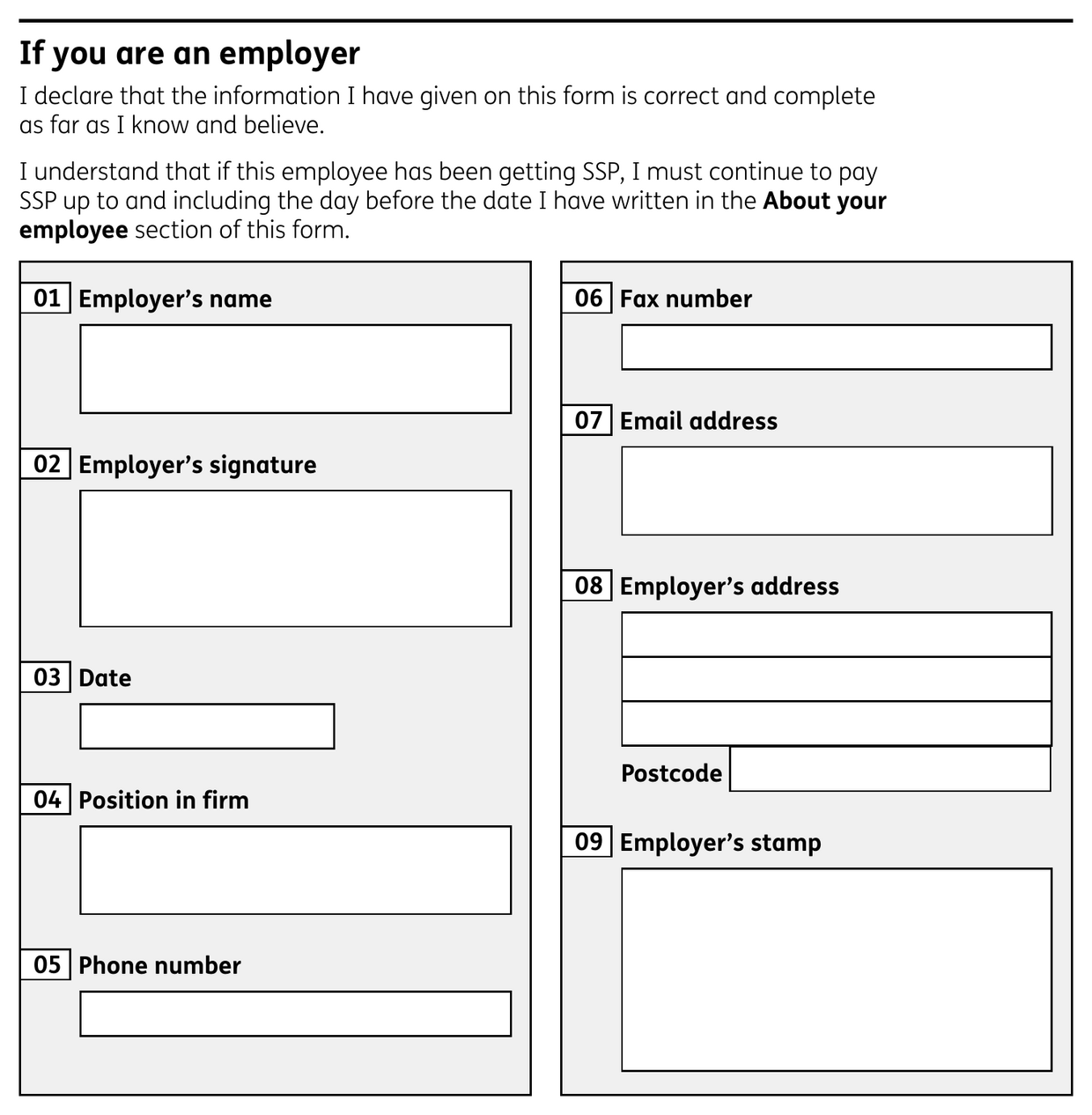
The first page the employer completes carries a declaration that the details are correct and, importantly, that where the employee has been receiving SSP the employer must keep paying it up to the day before the date entered in the employee section. The boxes themselves record the employer's own identifying details.
Employer's name. The trading or legal name of the business issuing the form.
Employer's signature. Signed as a declaration that the information is correct and complete.
Date. The date the employer signs the form.
Position in firm. The role of the person completing it, for example director or payroll manager.
Phone number. A daytime contact number for the employer.
Fax number. Optional, and rarely used in practice.
Email address. A contact email for the employer.
Employer's address. The business address, including postcode.
Employer's stamp. An optional company stamp where the business uses one.
About your employee (boxes 10 to 17)
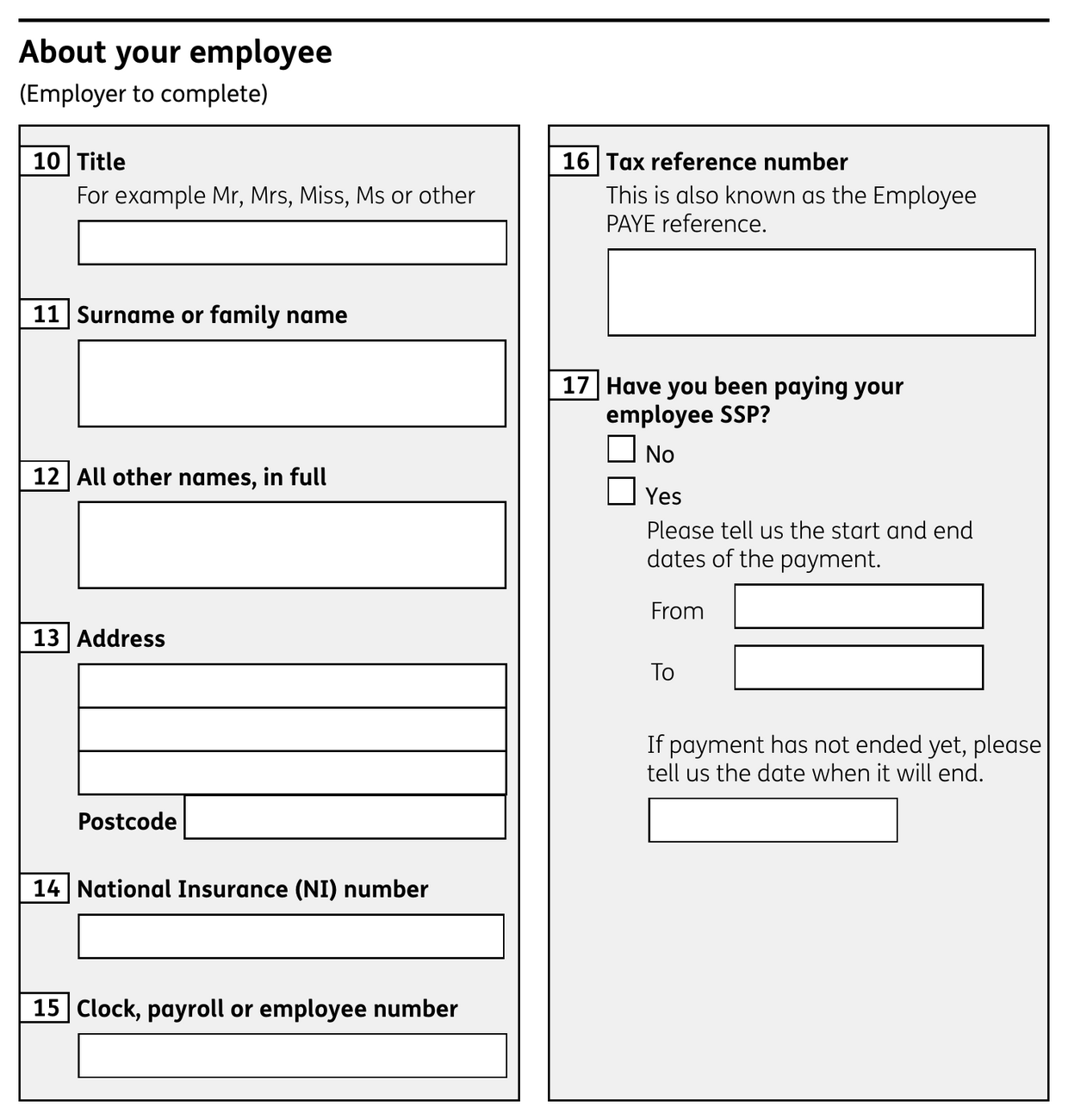
The second section identifies the employee and confirms whether SSP has been paid. Accurate dates in box 17 matter, because they tell the Department for Work and Pensions when the employer's liability ends and the benefit claim can begin.
Title. For example Mr, Mrs, Miss, Ms or other.
Surname or family name. The employee's family name.
All other names, in full. The employee's given names, written out in full.
Address. The employee's home address, including postcode.
National Insurance (NI) number. Used to match the record to the employee at the Department for Work and Pensions.
Clock, payroll or employee number. The employer's internal reference for the employee.
Tax reference number. Also known as the Employee PAYE reference.
Have you been paying your employee SSP? Tick No or Yes. If Yes, give the From and To dates of the payment, or the date it will end if it is still running.
Why Statutory Sick Pay is not payable
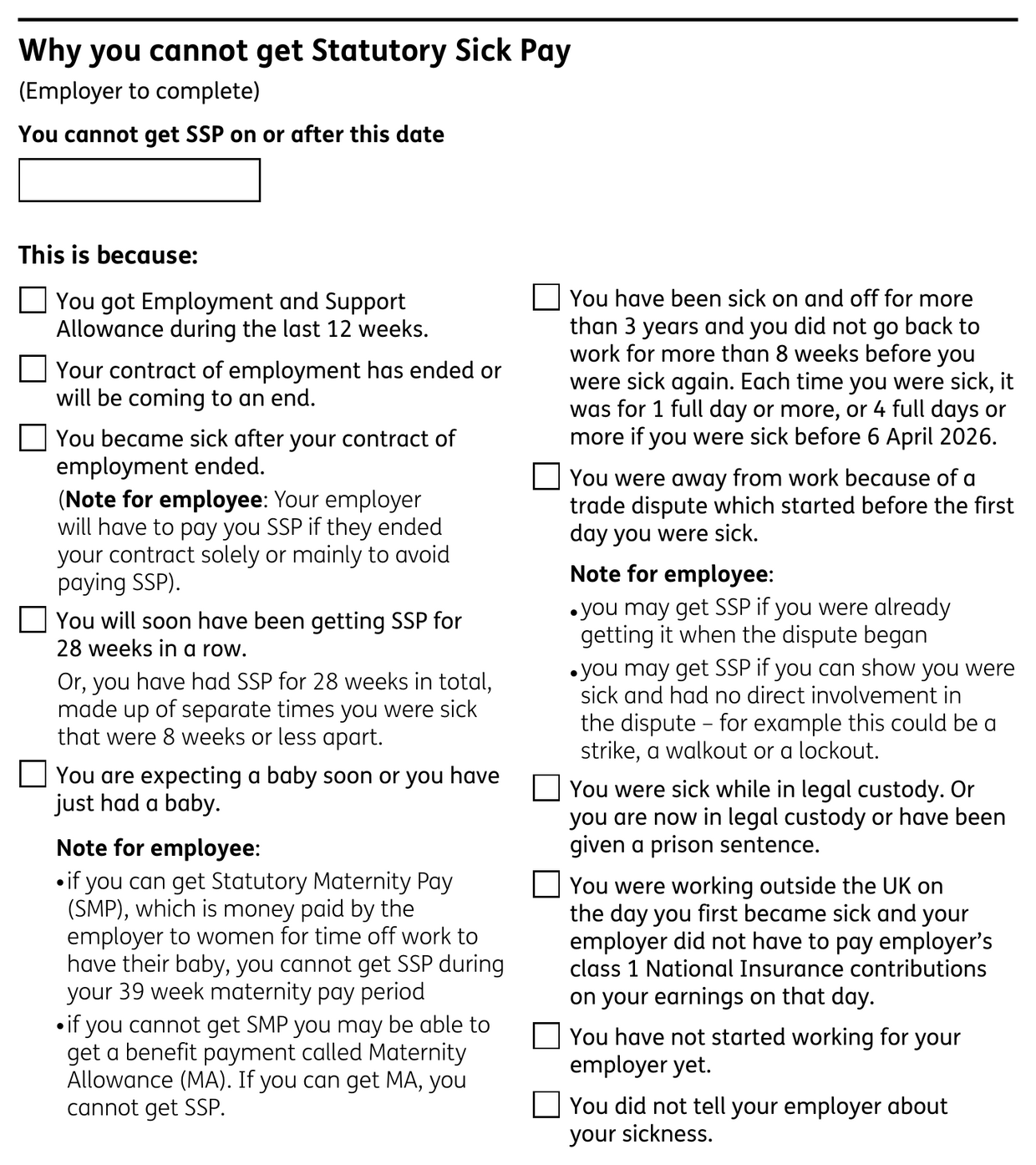
The final employer page records the date from which SSP is no longer payable, followed by a checklist of the reason. The employer ticks the single reason that applies, from a list that includes reaching the 28-week maximum, a contract ending, or the employee never having qualified. One line on the form still refers to a four-day sickness threshold that applied before 6 April 2026, a reminder that the waiting-day rule was removed from that date. The full set of non-qualifying reasons is set out in the table earlier in this article.
The two situations that trigger an SSP1
There are only two reasons to issue an SSP1, and they carry different deadlines. The first is that the employee's SSP is coming to an end. The second is that the employee never qualified for SSP at all [1].
The table below sets out the scenario, the trigger and the deadline for each.
| Situation | What triggers the form | Deadline to issue SSP1 |
|---|---|---|
| SSP ends unexpectedly while the employee is still sick | The 28-week maximum is reached, or entitlement otherwise ceases | Within 7 days of SSP ending |
| SSP is expected to end before the sickness does | The employer can foresee the 28 weeks running out | On or before the beginning of the 23rd week of SSP |
| The employee does not qualify for SSP at all | A failed eligibility condition on the first day of sickness | Within 7 days of the first day off sick |
These deadlines come directly from HMRC's employer guidance and are not discretionary [1]. Sending the 23rd-week form early is sensible practice, because it gives the employee time to apply for Employment and Support Allowance before SSP actually stops, avoiding a break in income [1].
When Statutory Sick Pay is ending
The most common trigger is the 28-week ceiling. The maximum liability in an unlinked period, or in a series of linked periods, is 28 times the weekly rate [5]. Once an employee has had 28 weeks of SSP, no more is due, and the employer must issue the SSP1 so the employee can claim a benefit instead [3].
Entitlement can also end before 28 weeks. A continuous series of linked periods of incapacity that lasts more than three years exhausts SSP entitlement, even where fewer than 28 weeks have actually been paid [12]. In either case, an employer who can see the end coming should issue the form on or before the start of the 23rd week so the transition to benefits is seamless [1].
When the employee never qualified
The second trigger is an employee who fails an eligibility condition from the outset. Here the form must be sent within 7 days of the first day of sickness absence, so the employee can claim Universal Credit or Employment and Support Allowance without delay [6]. The reasons for non-qualification are specific and listed in HMRC guidance [1].
It is worth noting that one historic reason for non-qualification has disappeared. Until 6 April 2026, an employee whose average weekly earnings fell below the Lower Earnings Limit received no SSP and was issued an SSP1 on that basis [11]. The Employment Rights Act 2025 removed that earnings test, so low earners now qualify and receive 80% of their average weekly earnings rather than a refusal, a shift covered in detail in the guide to what changed in the SSP reform [13].
Reasons an employee does not qualify for SSP
When an employee fails to qualify, the SSP1 records the reason. The exceptions are tightly defined, and a payroll bureau platform managing many client schemes needs to apply them consistently across every employer it runs.
| Reason SSP is not payable | Detail |
|---|---|
| The 28-week maximum has already been paid | No further SSP is due in the same or a linked period |
| The employee is receiving Statutory Maternity Pay or Maternity Allowance | Special rules apply to pregnancy and new mothers |
| Pregnancy-related illness in the 4 weeks before the week the baby is due | SSP is displaced by maternity provisions |
| The employee was in custody or on strike on the first day of sickness | Including any linked period |
| The employee works outside the EU and the employer is not liable for their National Insurance | No SSP obligation arises |
| The employee received Employment and Support Allowance within 12 weeks of starting or returning to work | A recent ESA claim blocks fresh SSP |
Each of these is drawn from HMRC's published eligibility list [1]. To qualify in the first place, an employee must have a contract of service, have done some work under it, have been sick for at least one full working day, and have given proper notice of sickness, the conditions explained in the overview of what Statutory Sick Pay is [14]. The period of incapacity for work is now defined as at least one full working day, a change from the previous four-day threshold [1].
What happens after the SSP1: the move to ESA
The SSP1 exists so the employee can claim a state benefit once the employer's sick pay stops. The two routes are New Style Employment and Support Allowance, a contributory benefit based on National Insurance record, and Universal Credit, an income-related benefit [8]. The employee uses the dates and reasons on the SSP1 to support the claim [2].
New Style ESA is paid at a personal rate that depends on age during the initial assessment phase, then rises once a work capability assessment places the claimant in a component group [10]. The weekly figures for the 2026-27 tax year are set out below.
| ESA element | Weekly amount 2026-27 |
|---|---|
| Assessment phase, claimant under 25 | £75.65 |
| Assessment phase, claimant 25 or over | £95.55 |
| Work-related activity component | £37.95 |
| Support component | £50.35 |
These rates are published in the annual benefit and pension uprating [15]. New Style ESA is not means-tested and is unaffected by a partner's earnings or by most savings, which makes it the usual first port of call for an employee leaving SSP [9]. An employee may also claim Universal Credit alongside it where their household circumstances allow [16].
The employer's part in the handover
The employer does not pay ESA and is not involved in assessing it. The duty stops at issuing an accurate SSP1 on time [6]. Where an employer knows an employee will be off for more than 28 weeks, the form can be completed early, before SSP ends, so the ESA claim is in train before the income stops [1].
Accurate dates matter at this handover. The SSP1 must show when SSP started, the weekly rate paid, and the date it ends, because the Department for Work and Pensions uses those figures to set the ESA start date [2]. Payroll records that capture every qualifying day make the form straightforward to complete, which is one reason employers embed sick pay tracking inside an HMRC-recognised payroll API rather than reconstructing it by hand.
Record keeping and Real Time Information
SSP is paid through payroll like any other earnings, with income tax and National Insurance deducted, and is reported to HMRC through Real Time Information on the Full Payment Submission [3]. Because SSP is not recoverable, there is no Employer Payment Summary entry to reclaim it, unlike family-related statutory payments [3].
HMRC can ask to see sickness records if there is a dispute over an SSP payment, so an employer should retain evidence of qualifying days, average weekly earnings and the dates SSP was paid [3]. Software that holds the HMRC Recognised badge submits the FPS automatically and keeps the underlying SSP record, which is the same data the SSP1 draws on [12]. Sole traders and very small employers issuing one-off documents can produce a compliant instant payslip that reflects the correct SSP figure.
Check whether SSP is payable before issuing SSP1
An SSP1 is only correct once you have established that SSP is not payable, or that it has run out. The Moonworkers SSP calculator applies the earnings test and the 28-week limit for the 2026 tax year, which is the check to run before the form goes out.
Count every calendar day of sickness, including weekends and days off. If the employee is still off, enter today as the last day for the amount due so far.
Statutory Sick Pay due
£0.00
Three quick steps: the absence dates, the working pattern, then the last few payslips. The calculation updates here.
Sick pay handled automatically, from day one
Moonworkers applies the 2026 SSP rules on every payrun: average weekly earnings, the 80% taper, linked absences and the 28-week cap, all itemised on HMRC-compliant payslips.
Conclusion
The SSP1 is a small form with an outsized role. It is the formal point at which an employer's sick pay liability ends and the state benefit system takes over, and the two deadlines attached to it, 7 days for an unexpected end and the 23rd week for an expected one, leave little room for delay. Issued accurately and on time, it protects both the employee's income and the employer's compliance position.
The wider direction of travel makes the form more visible, not less. The removal of the Lower Earnings Limit on 6 April 2026 brought a large group of previously excluded low earners into SSP, which means more sickness absences now generate an SSP entitlement, and in time more of them will reach the 28-week ceiling where the SSP1 is due. Absence tracking that surfaces that ceiling before it arrives is becoming a core part of running compliant UK payroll.
Frequently asked questions
Who fills in the SSP1 form, the employer or the employee?
The employer completes the SSP1 form. It records the dates Statutory Sick Pay was paid, the weekly rate, and the date payment ends or the reason the employee did not qualify [2]. The employee then uses the completed form to support a claim for Employment and Support Allowance or Universal Credit [1].
How long does an employer have to issue an SSP1?
It depends on the trigger. If SSP ends unexpectedly while the employee is still sick, the form must be sent within 7 days of payment stopping. If the end is foreseeable, it must be sent on or before the beginning of the 23rd week of SSP. If the employee never qualified, the form is due within 7 days of their first day off sick [1].
Can an employee get money after their SSP runs out?
Yes. An employee whose SSP has ended may claim New Style Employment and Support Allowance, a contributory benefit based on National Insurance record, or Universal Credit, depending on their circumstances [8]. The SSP1 provides the dates and reasons the Department for Work and Pensions needs to assess the claim [2].
Does the employer pay Employment and Support Allowance?
No. Employment and Support Allowance is a state benefit paid by the Department for Work and Pensions, not by the employer [10]. The employer's responsibility ends with paying Statutory Sick Pay for up to 28 weeks and issuing an accurate SSP1 on time so the employee can claim ESA [6].