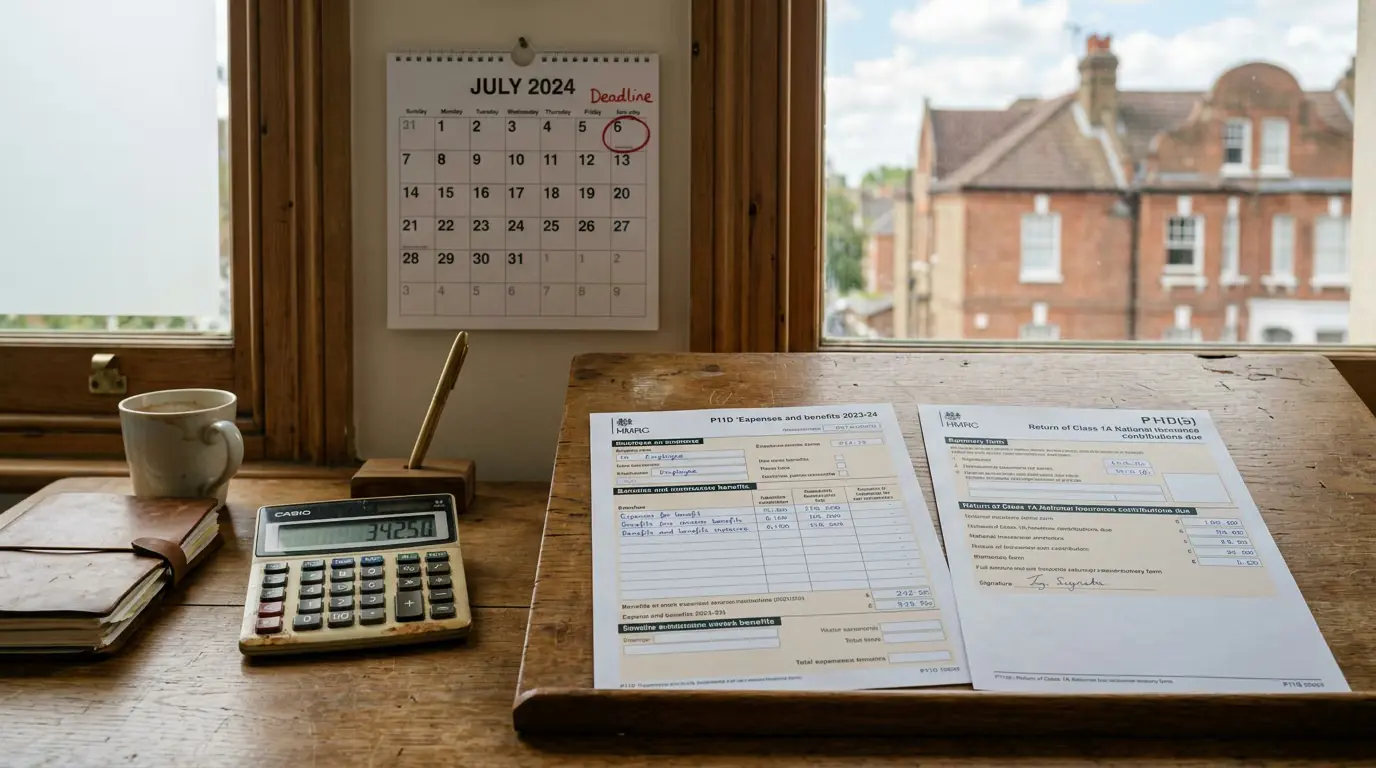
The way UK employers report benefits in kind is in the middle of its biggest overhaul in a decade. Paper P11D forms were abolished from 6 April 2023, the Class 1A National Insurance rate rose to 15% on 6 April 2026, and from 6 April 2027 payrolling the most common benefits becomes mandatory rather than optional [1] [2]. Around 920,000 people received a company car in the 2024 to 2025 tax year, so the number of employers affected by these changes runs into the hundreds of thousands [3].
The P11D is the form an employer files after the tax year to report benefits such as company cars and private medical cover, paired with a P11D(b) that declares the employer's Class 1A National Insurance [4]. Each of the recent changes affects how, when or whether that form is filed, and getting the sequence right matters because the penalties for late filing are automatic.
This article sets out the P11D changes an employer needs to track: the move to online-only filing, the higher Class 1A rate, the phased shift to mandatory payrolling, the effect on the P11D(b), and the practical steps to stay compliant through the transition.
Key takeaways
- Paper P11D and P11D(b) forms were withdrawn from 6 April 2023, and filing is now online only except where a business has ceased trading [1].
- Employer Class 1A National Insurance rose to 15% for the 2026-27 tax year [5].
- From 6 April 2027, payrolling of cars, car fuel, vans, van fuel and medical benefits becomes mandatory [2].
- The P11D(b) survives the change, because Class 1A National Insurance is still declared annually [6].
- Late filing of a P11D(b) costs £100 for every 50 employees for each month it is overdue [6].
The end of the paper P11D
The first major change was the withdrawal of paper filing. From 6 April 2023, employers have had to submit P11D and P11D(b) forms online, either through HMRC's PAYE Online service or through payroll software, with paper accepted only where a business has stopped trading [1]. The change applied to original returns and to corrections, so an amended P11D also has to go through the online route [7].
For most employers the shift was administrative, but it set the direction for everything that followed: benefit reporting is moving to digital, real-time channels, and the paper form was the first casualty [4]. Employers using HMRC-recognised payroll software file the P11D and P11D(b) directly from the payroll record, which removes the manual re-keying that the online service otherwise requires [1].
Correcting a P11D under the online rules
The online-only rule changed how corrections work too. An amended P11D must include all the benefits for the employee, not only the item that changed, and a corrected P11D(b) must state the total Class 1A National Insurance due rather than the difference [7]. This full-restatement approach means an employer correcting a single figure still resubmits the complete picture, which is simpler to get right when the data comes straight from a payroll system rather than a spreadsheet [1].
The higher Class 1A National Insurance rate
The second change is a cost increase rather than a process one. Employer Class 1A National Insurance, charged on the taxable value of benefits, rose to 15% for the 2026-27 tax year, up from the previous 13.8% [5]. Class 1A is an employer-only charge, so the employee pays income tax on a benefit but no National Insurance, while the employer carries the 15% [8].
The rise matters because benefits are a meaningful cost line. With the total taxable value of Class 1A benefits reaching £9.5 billion in 2024 to 2025, a 1.2-percentage-point increase in the rate lifts the aggregate employer bill materially [3]. The table below shows the effect of the rate change on a single benefit.
| Benefit value | Class 1A at 13.8% | Class 1A at 15% |
|---|---|---|
| £3,600 company car | £496.80 | £540.00 [[5]](https://www.gov.uk/government/publications/cwg5-class-1a-national-insurance-contributions-on-benefits-in-kind/2026-class-1a-national-insurance-contributions-on-benefits-in-kind-termination-payments-and-sporting-testimonial-payments) |
| £1,200 medical cover | £165.60 | £180.00 [[5]](https://www.gov.uk/government/publications/cwg5-class-1a-national-insurance-contributions-on-benefits-in-kind/2026-class-1a-national-insurance-contributions-on-benefits-in-kind-termination-payments-and-sporting-testimonial-payments) |
The deadlines have not changed
Despite the higher rate, the P11D calendar is unchanged. The P11D and P11D(b) are due by 6 July after the tax year ends, the employee copy by the same date, and the Class 1A payment by 22 July where paid electronically, or 19 July by post [6]. A late P11D(b) attracts a penalty of £100 for every 50 employees for each month or part-month it is overdue, and interest runs on Class 1A paid after the deadline [6]. The higher rate simply raises the amount at stake if those deadlines are missed [1].
Mandatory payrolling from 6 April 2027
The largest change is still to come. From 6 April 2027, reporting income tax and Class 1A National Insurance on certain benefits through the payroll in real time becomes mandatory, replacing the after-the-year P11D for those benefits [2]. The original plan set an April 2026 start, but HMRC moved it back a year to give employers and software developers more time to prepare [9]. The mechanism is the Full Payment Submission, which will carry benefit values so both income tax and Class 1A can be reported each pay period [2].
The phased timeline
The rollout is split into two phases. Phase one, from 6 April 2027, covers company cars, car fuel, vans, van fuel and employer-provided medical benefits, which together account for roughly 92% of all benefits provided in the UK [2] [10]. Phase two, from 6 April 2028, brings in most remaining benefits, leaving only beneficial loans and living accommodation as voluntary [2]. The table below summarises what changes and when.
| Date | Change | Benefits in scope |
|---|---|---|
| 6 April 2023 | Paper filing withdrawn | All P11D and P11D(b) forms [[1]](https://www.gov.uk/guidance/how-to-complete-forms-p11d-and-p11db) |
| 6 April 2026 | Class 1A rate rises to 15% | All Class 1A benefits [[5]](https://www.gov.uk/government/publications/cwg5-class-1a-national-insurance-contributions-on-benefits-in-kind/2026-class-1a-national-insurance-contributions-on-benefits-in-kind-termination-payments-and-sporting-testimonial-payments) |
| 6 April 2027 | Payrolling becomes mandatory | Cars, car fuel, vans, van fuel, medical [[2]](https://www.gov.uk/guidance/draft-guidance-and-legislation-to-aid-preparation-for-reporting-benefits-in-kind-in-real-time/the-phased-introduction-of-mandatory-payrolling-for-benefits-in-kind) |
| 6 April 2028 | Payrolling extends further | Most remaining benefits [[2]](https://www.gov.uk/guidance/draft-guidance-and-legislation-to-aid-preparation-for-reporting-benefits-in-kind-in-real-time/the-phased-introduction-of-mandatory-payrolling-for-benefits-in-kind) |
What happens to the RTI data
The change also simplifies what payroll software transmits. HMRC has confirmed that mandatory payrolling removes 94 real-time information data fields tied to the old benefit-reporting process, and that the technical specifications for developers will be updated to reflect the revised data requirements from April 2027 [2]. Employers who want to payroll the voluntary categories of loans and accommodation will need to register, and HMRC expects that registration service to open from November 2026 [9]. Platforms embedding payroll through an HMRC-recognised payroll API inherit the revised data requirements from the engine rather than rebuilding their own submission logic [2].
What survives the changes
It is easy to assume mandatory payrolling ends the P11D altogether. It does not. Two obligations survive, and employers that overlook them risk a penalty even after the benefits themselves are payrolled.
The P11D(b) and Class 1A
The P11D(b) continues, because Class 1A National Insurance still has to be declared and paid annually even when the underlying benefits are payrolled [7]. An employer that payrolls every benefit no longer files individual P11D forms, but it still submits a P11D(b) by 6 July and pays the Class 1A by 22 July [6]. The annual employer-level return is the part of the P11D system that the reforms retain [1].
The voluntary benefits
The P11D also survives for the benefits that stay voluntary. Beneficial loans and living accommodation are excluded from mandatory payrolling, so an employer that provides them and chooses not to payroll them voluntarily continues to report them on a P11D after the tax year [2]. For those employers the form shrinks to a shorter list of items rather than disappearing, which is why the P11D remains part of the year-end routine even after 2028 [4].
What the changes mean for employees
The changes are framed around employer obligations, but they reshape what employees see too. Under the P11D route, the tax on a benefit is collected through a tax-code adjustment that reduces the tax-free allowance, often a year or more after the benefit was received [8]. As benefits move to payrolling, that lag disappears: the tax is taken on the payslip in the pay period the benefit is enjoyed, and the benefit is removed from the code [11]. The Moonworkers guide to how a P11D affects a tax code sets out that mechanism in full.
Fewer year-end surprises
Real-time collection reduces the under and overpayments that the estimate-based coding system produces. Because the P11D route relies on HMRC estimating the current year's benefit from the previous year's form, an employee who changes or gives up a benefit can carry the wrong deduction for months [12]. Payrolling settles the exact value each period, so the reconciliation gap at year end shrinks [11]. For the detail of the payrolling process itself, the Moonworkers guide to payrolling benefits in kind walks through each step [2].
How employers should prepare
The changes reward employers that move early. An employer already payrolling benefits voluntarily is most of the way to the phase-one requirement, while one still relying on the P11D has a process to build before April 2027 [11]. Registering to payroll voluntarily now lets a business test real-time collection on a live payroll before it becomes compulsory, and registration must be completed before the start of the tax year in which payrolling begins [11].
Software readiness is the other half of the preparation. Real-time benefit reporting depends on payroll software that can carry benefit values on the Full Payment Submission and apply the revised data fields from April 2027 [2]. Payroll software that holds the HMRC Recognised badge submits the Full Payment Submission automatically and reflects rate and rule changes without manual reconfiguration, which matters when both the Class 1A rate and the RTI data set are moving [5]. Accountants handling this across a client base usually manage the transition from a single payroll bureau platform, which flags which schemes still file a P11D and which have moved to payrolling [7].
Common errors to avoid during the transition
A period of change is when reporting mistakes are most likely, and P11D errors are a frequent trigger for HMRC compliance checks. The most common is filing a P11D for a benefit that has already been payrolled, which taxes the same benefit twice, once on the payslip and once through the form [11]. Another is forgetting the P11D(b) after moving all benefits to payrolling, on the mistaken assumption that payrolling ends every year-end obligation [7].
A third is treating exempt items as reportable, or reportable items as exempt. Business travel paid at HMRC rates and standard work equipment are exempt and should not appear on a P11D, while a company car or medical policy must be reported unless it is payrolled [8]. Keeping the benefit records that support each figure for the required period is part of staying audit-ready, whether an employer runs payroll for a small business directly or hands it to a bureau [12].
Conclusion
The P11D is not being abolished so much as narrowed. Online-only filing digitised the form, the 15% Class 1A rate raised the cost of every benefit, and mandatory payrolling from 6 April 2027 shifts the tax on cars, vans and medical cover out of the year-end form and into the payroll itself. What remains is a smaller P11D for the voluntary benefits and an annual P11D(b) that still settles the employer's Class 1A National Insurance.
For employers, the changes point in one direction: benefit reporting is becoming a real-time, payroll-based task rather than an annual paperwork exercise. The businesses that register to payroll voluntarily, confirm their software is ready for the revised data requirements, and keep the 6 July and 22 July deadlines in view through the transition will find the shift is mostly a matter of switching on a process their payroll already supports. Those that wait until 2027 will be building that process against a live deadline.
Frequently asked questions
Is the P11D being abolished?
No. Mandatory payrolling from 6 April 2027 removes the individual P11D for cars, vans and medical benefits, but the P11D survives for benefits that stay voluntary, such as beneficial loans and living accommodation [2]. The P11D(b) that declares Class 1A National Insurance also continues each year [6]. So the form narrows rather than disappears [4].
Can I still file a paper P11D?
No, other than in one narrow case. Since 6 April 2023, P11D and P11D(b) forms must be filed online, through PAYE Online or payroll software [1]. The only exception is an employer that has ceased trading, which may still use paper [1]. Amended returns must also go through the online route [7].
What is the Class 1A National Insurance rate now?
Employer Class 1A National Insurance is 15% for the 2026-27 tax year, up from 13.8%, charged on the taxable value of benefits in kind [5]. It is an employer-only charge, so employees pay income tax on a benefit but no National Insurance on it [8]. The Class 1A is declared on the P11D(b) and paid by 22 July where paid electronically [6].
When does mandatory payrolling of benefits start?
Mandatory payrolling is phased in from 6 April 2027 for company cars, car fuel, vans, van fuel and employer-provided medical benefits [2]. Most other benefits follow from 6 April 2028, while loans and living accommodation remain voluntary [2]. The start was moved from an original April 2026 date to allow more preparation time [9].
Image prompt for Imagen (also in frontmatter)
Documentary still life, a printed P11D form and a P11D(b) summary on a wooden office desk beside a calculator and a wall calendar with 6 July circled, natural light from a window, late morning, palette of warm white, paper cream, oak and brushed brass, an office window with a red-brick building visible out of focus, off-centre composition with the forms in the lower-right two-thirds, shot on a Hasselblad X2D at 55mm f/4, photojournalism, soft film grain, no AI artefacts, no warped text, landscape orientation 16:9.