Check what a tax code means
Every UK tax code explained, with exact tax-free pay for each pay schedule.
A P11D reports the taxable value of a benefit such as a company car or private medical insurance, and HMRC turns that figure into a tax-code adjustment that collects the tax owed [1]. Around 920,000 people received a company car in the 2024 to 2025 tax year, and the total taxable value of all Class 1A benefits reached £9.5 billion, so the number of tax codes touched by a P11D each year is substantial [2].
The tax code is the instrument that tells an employer how much tax-free pay an employee is entitled to before deductions begin [3]. When a benefit is reported on a P11D, HMRC reduces that tax-free amount so the tax on the benefit is spread across future pay, which is why a company car or medical cover almost always lowers the code and raises the deductions.
This article explains what a P11D is, how HMRC converts a benefit into a coding adjustment, why the tax-free allowance falls, when a K code appears, how a benefit received in one year can affect a later year, and how payrolling changes the picture entirely.
Key takeaways
- A P11D reports the cash equivalent of a benefit, and HMRC uses that value to adjust the employee's tax code [1].
- Benefits reduce the tax-free allowance, so the standard 1257L code drops and more tax is deducted from each payslip [3].
- A K code appears when the value of benefits and other deductions is greater than the Personal Allowance [3].
- A benefit reported after the tax year can affect a later year's code, creating a lag the employee may not expect [4].
- Payrolling a benefit removes it from the tax code, because the tax is collected in real time instead [5].
What a P11D reports
A P11D is the form an employer completes after the end of the tax year to tell HMRC about benefits in kind and expenses provided to an employee or director [1]. Each benefit carries a cash equivalent, the value HMRC rules assign to it, and that figure is what feeds into the tax calculation [6]. Since 6 April 2023, P11D and P11D(b) forms must be filed online rather than on paper, except where a business has ceased trading [7].
The employer files the P11D by 6 July after the tax year ends, and gives the employee a copy of the same information by the same date [8]. That copy matters, because it is the record an employee can use to check that the value HMRC has coded against their pay is correct [4].
The cash equivalent, not the cost
The figure on a P11D is the taxable value set by HMRC rules, which is not always the same as what the benefit cost the employer [6]. For a company car, the value is the list price multiplied by an appropriate percentage tied to the car's carbon dioxide emissions, so a low-emission car produces a much smaller charge than a high-emission one [9]. The average taxable value of a company car fell to £3,330 in 2024 to 2025, driven by the rise of electric cars, which now make up 51% of company cars [2].
How HMRC turns a benefit into a code adjustment
A tax code such as 1257L tells the employer to give the employee £12,570 of tax-free pay across the year before any income tax is deducted [3]. The digits are the tax-free amount divided by ten, and the letter signals the type of allowance [10]. When a benefit is reported, HMRC reduces the tax-free amount by the value of that benefit, so the code falls and the employer deducts tax on a larger slice of pay [4].
Tax on benefits is usually collected through this coding adjustment, notified by HMRC to the employer after the P11D has been processed [2]. The mechanism is simple arithmetic: the allowance shrinks, the taxable pay grows, and the deduction rises to match the tax due on the benefit [3].
A worked example
Consider an employee on the standard code with a company car valued at £3,600. HMRC reduces the tax-free allowance from £12,570 to £8,970, and the code becomes 897L [3]. The employee now pays tax on an extra £3,600 of income across the year, which at the 20% basic rate is £720, collected as roughly £60 a month [11]. The table below shows how the same £3,600 benefit lands differently depending on the employee's tax band.
| Employee tax band | Rate on the benefit | Annual tax on a £3,600 benefit |
|---|---|---|
| Basic rate | 20% | £720 [[11]](https://www.gov.uk/income-tax-rates) |
| Higher rate | 40% | £1,440 [[11]](https://www.gov.uk/income-tax-rates) |
| Additional rate | 45% | £1,620 [[11]](https://www.gov.uk/income-tax-rates) |
The employer's payroll applies whatever code HMRC issues, and modern UK payroll software updates the code automatically when HMRC sends an electronic coding notice, so the change takes effect on the next payrun without manual entry [5].
Which benefits change a tax code
Not every perk an employer provides affects the tax code, because some are exempt from reporting and others are taxed as ordinary pay [6]. A benefit changes the code only when it is a taxable benefit in kind that is reported rather than payrolled [1]. The table below shows how the most common benefits are treated.
| Benefit | Reported on a P11D | Effect on the tax code |
|---|---|---|
| Company car | Yes, unless payrolled | Reduces the tax-free allowance [[6]](https://www.gov.uk/tax-company-benefits) |
| Private medical insurance | Yes, unless payrolled | Reduces the tax-free allowance [[1]](https://www.gov.uk/paye-forms-p45-p60-p11d/p11d) |
| Interest-free loan over £10,000 | Yes | Reduces the allowance by the notional interest [[6]](https://www.gov.uk/tax-company-benefits) |
| Business travel at HMRC rates | No, exempt | No effect [[17]](https://www.gov.uk/expenses-and-benefits-travel) |
| Work uniform or tools | No, exempt | No effect [[6]](https://www.gov.uk/tax-company-benefits) |
Directors and closely held companies
Directors are a frequent source of coding errors because they often take a low salary alongside benefits, so a car or loan can outweigh a small salary and push the code into K territory quickly [3]. A director of a personal company should check that the benefits coded against their salary match what the company has actually provided, since the same person often signs off the P11D and receives it [1]. Accountants managing benefits across many director-clients typically track this from a multi-client payroll dashboard that flags each scheme's benefits before the P11D deadline [8].
When a K code appears
Most benefit adjustments simply lower the number in the code, but sometimes the value of benefits and other deductions is greater than the Personal Allowance itself. When that happens, the allowance cannot absorb the deduction, and HMRC issues a K code [3]. A K code works in reverse: instead of tax-free pay, it adds a notional amount to taxable pay, so the employee is taxed on more than they actually earn from the employer [10].
The 50% safeguard
A K code can produce a large deduction, so a statutory limit protects the employee's take-home pay. No PAYE deduction driven by a tax code can take more than 50% of an employee's gross pay in a pay period, regardless of the code or the tax owed [10]. Where a K code would breach that limit, the excess is carried forward rather than taken all at once, which spreads the recovery and prevents an employee's pay being wiped out by a single deduction [3]. Businesses running payroll for a mix of directors and staff, such as those using a small business payroll platform, rely on the software to apply this cap automatically [5].
Why a benefit can affect a later tax year
The P11D route creates a timing lag that surprises many employees. A benefit received in one tax year is reported the following July, and HMRC may collect the tax through the code in a still later year [4]. HMRC also estimates the current year's benefit based on the previous year's P11D, so an employee who keeps the same company car sees the code carry the estimate forward automatically [12].
Keeping the estimate accurate
Because HMRC works from an estimate, a change in benefits should be reported promptly to avoid an under or overpayment building up. An employee can check and update the benefits shown in their code through the Check your Income Tax online service or the personal tax account, which lists each company benefit and the value used in the code [12]. Reporting a car that has been given back, or medical cover that has ended, prompts HMRC to reissue the code so the deduction matches the benefit actually received [13]. This is also where an employee resolves a code they believe is wrong, rather than waiting for the year-end reconciliation [14].
How payrolling changes the tax code
Payrolling a benefit removes it from the tax code entirely. When an employer payrolls a benefit, the tax is collected in real time through the payroll, so HMRC takes the benefit out of the code to avoid taxing it twice [5]. The employee's code returns to reflect only their allowances, while the benefit value appears on the payslip and is taxed month by month [15].
This matters because payrolling is becoming compulsory. From 6 April 2027, payrolling of company cars, car fuel, vans, van fuel and employer-provided medical benefits becomes mandatory, phased in ahead of most other benefits from 6 April 2028 [16]. As payrolling spreads, the coding adjustment that has long been the main way benefits affect a tax code will apply to fewer benefits, and the payslip will carry the charge instead [16]. Platforms that embed payroll through an HMRC-recognised payroll API already carry benefit values on the payroll submission, so the real-time treatment is handled in the engine [5].
What happens if the code was wrong
Because the coding of a benefit relies on an estimate, the tax collected during the year does not always match the tax actually due once the P11D is processed [4]. After the tax year ends, HMRC reconciles the income tax paid against the tax owed and issues a calculation where the two differ [13]. Where too little tax has been collected, the shortfall is usually recovered by adjusting a later year's code rather than demanding an immediate payment, which is how a benefit from one year reaches into the next [4].
An employee who has overpaid, perhaps because a car was returned mid-year without the code being updated, is due a refund once the reconciliation completes [13]. Checking the benefits listed against the code during the year is the simplest way to keep the estimate close to reality and reduce the size of any year-end adjustment [12].
Check what a tax code means
An employee who wants to decode the letters and numbers in a code, and see the effect of a benefit adjustment, can use the Moonworkers tax code checker, which explains each element against the 2026-27 allowances.
On your payslip, P45 or P60. Suffixes W1, M1 or X welcome.
What you'll get
Enter any UK tax code to see:
- · what each letter and number means
- · which nation's rates apply (S and C prefixes)
- · cumulative vs emergency W1/M1/X basis
- · the exact tax-free pay for every pay schedule, to the penny
Try 1257L, a K code, or an emergency W1 code.
Payroll that applies every tax code correctly
Moonworkers runs the full HMRC exact percentage method on every payslip, including K codes, emergency codes and in-year code changes, and files RTI automatically.
Conclusion
A P11D affects a tax code through a single, consistent mechanism: the reported value of a benefit reduces the tax-free allowance, the code falls, and the employer deducts more tax to settle the charge across the year. Where benefits outweigh the allowance, a K code takes over and adds to taxable pay, subject to the 50% cap that protects take-home pay. The timing lag built into the P11D route is what makes benefits feel unpredictable, because a car or medical policy from one year can shape the code in a later one.
That older model is giving way to real-time collection. As mandatory payrolling arrives from 6 April 2027, more benefits will be taxed on the payslip rather than through the code, and the coding adjustment will become the exception rather than the rule. For now, an employee who checks the benefits listed against their code, and reports changes promptly, keeps the deduction accurate and avoids the year-end surprise that the P11D route can otherwise produce.
Frequently asked questions
Why did my tax code go down after getting a company car?
A company car is a taxable benefit, and HMRC reduces the tax-free allowance in the code by the car's cash equivalent so the tax is collected across the year [6]. A car valued at £3,600, for example, drops the standard 1257L code to 897L [3]. The lower the car's emissions, the smaller the benefit value and the smaller the reduction to the code [9].
What does a K in my tax code mean?
A K code means the value of benefits and other deductions is greater than the Personal Allowance, so instead of tax-free pay the code adds a notional amount to taxable pay [3]. It is common for employees with high-value benefits such as a car plus medical cover [10]. A statutory 50% limit stops a K code taking more than half of gross pay in any pay period [10].
How do I check the benefits used in my tax code?
An employee can sign in to the Check your Income Tax online service or the personal tax account to see each company benefit and the value HMRC has used in the code [12]. If a benefit has ended or changed, reporting it there prompts HMRC to reissue the code [13]. The P11D copy from the employer is the reference to check the figures against [1].
Does payrolling a benefit remove it from my tax code?
Yes. When a benefit is payrolled, the tax is collected in real time through the payroll, so HMRC removes the benefit from the tax code to prevent it being taxed twice [5]. The benefit then appears on the payslip as taxable pay instead of shrinking the code [15]. Payrolling of cars, vans and medical benefits becomes mandatory from 6 April 2027 [16].
Image prompt for Imagen (also in frontmatter)
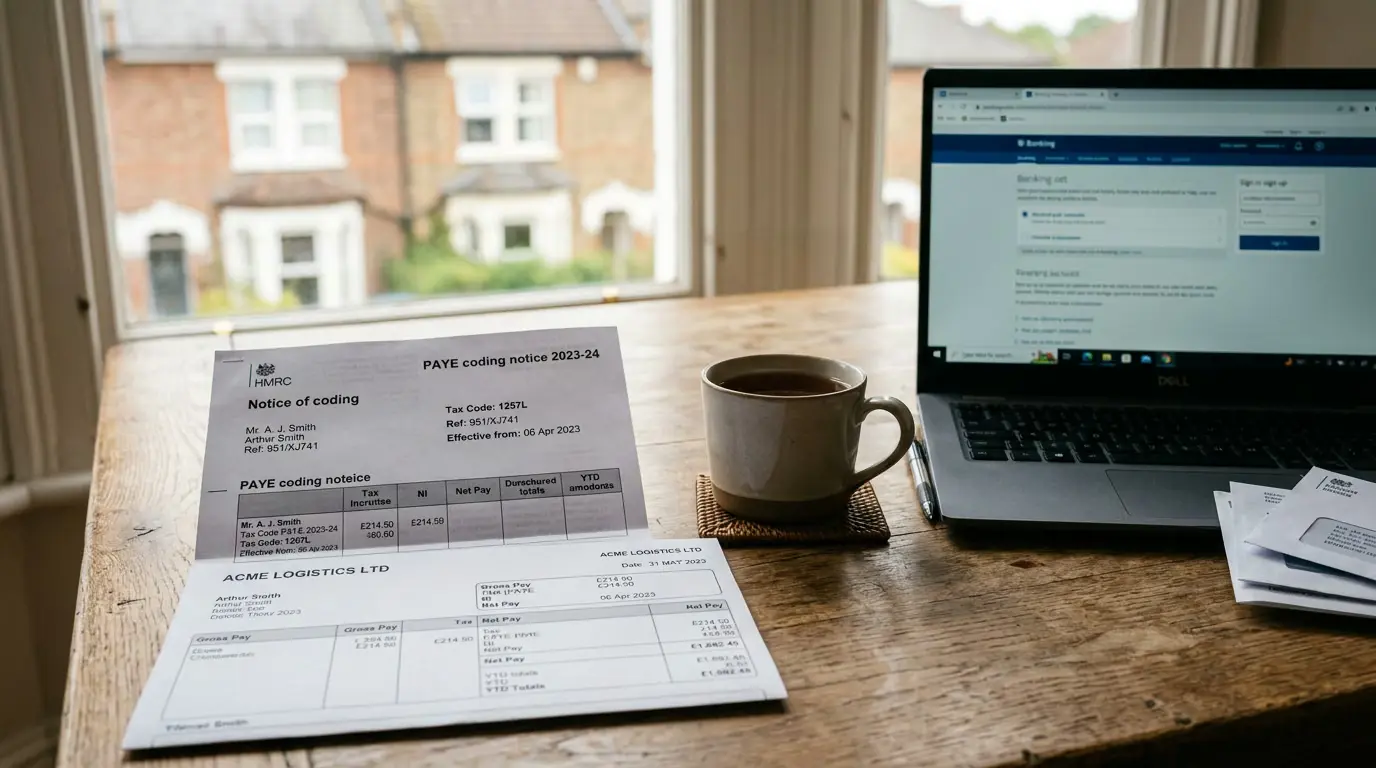
Documentary still life, a printed PAYE coding notice and a payslip on a wooden kitchen table next to a laptop and a mug of tea, soft natural daylight from a window, mid-morning, palette of warm white, oak, soft denim blue, a terraced house window visible slightly out of focus, off-centre composition with the papers in the lower-left two-thirds, shot on a Canon R6 at 50mm f/2.8, photojournalism, subtle film grain, no AI artefacts, no warped text, landscape orientation 16:9.