Work out Statutory Sick Pay
Day-one SSP under the 2026 rules: the lower of £123.25 or 80% of average weekly earnings.
Statutory Sick Pay runs for a maximum of 28 weeks in any single period of sickness, and since 6 April 2026 it has been payable from the first day of absence rather than the fourth [1]. At the 2026-27 weekly rate of £123.25, that 28-week ceiling caps a single claim at roughly £3,451 before it is exhausted [3].
The 28-week figure sounds simple, but the way those weeks are counted trips up many payroll teams. Absences can link together across gaps, only contracted working days count, and the point at which the clock stops depends on the shape of the employee's sickness rather than the calendar. For an employer running payroll in-house, getting the duration wrong means either underpaying a sick employee or continuing to pay Statutory Sick Pay after the legal entitlement has ended.
This article sets out how long Statutory Sick Pay lasts, how the 28-week maximum is measured, how separate absences link into a single entitlement, what changed on 6 April 2026, and what an employer must do with form SSP1 when the entitlement runs out.
Key takeaways
- Statutory Sick Pay lasts a maximum of 28 weeks in a single period of incapacity for work or a set of linked periods.
- Since 6 April 2026, Statutory Sick Pay is paid from day one of sickness, with the three waiting days abolished.
- Two absences separated by 56 days (8 weeks) or less link together and share one 28-week entitlement.
- Only qualifying days, the days an employee normally works, count towards the weeks of Statutory Sick Pay paid.
- When the 28 weeks are used up, the employer issues form SSP1 so the employee can claim Employment and Support Allowance.
The 28-week maximum, in plain terms
The upper limit on Statutory Sick Pay is 28 weeks. An employee who is continuously sick, or whose absences link together under the rules described below, cannot receive more than 28 weeks of Statutory Sick Pay from the same employer for that run of sickness [4]. Once 28 weeks have been paid, liability ends, and the employer stops paying regardless of whether the employee is still unwell [1].
Expressed in money, the maximum liability is 28 times the weekly rate. At the 2026-27 rate of £123.25 a week, an employee entitled to the full flat rate could receive up to £3,451 across the whole period before Statutory Sick Pay is exhausted [3]. An employee earning less than the flat rate receives 80% of their average weekly earnings instead, so their 28-week total is lower, as the breakdown of the SSP rate for 2026-27 explains.
What the law counts as a week
The 28-week ceiling is measured against the weekly rate, not against calendar weeks of absence. HMRC guidance frames the maximum as 28 times the relevant weekly rate in an unlinked period, or across a series of linked periods [4]. Because Statutory Sick Pay is worked out on qualifying days, an employee who is off for only part of most weeks uses up the entitlement more slowly than one absent for every working day [7].
That distinction matters for long, intermittent conditions. An employee with a fluctuating illness who takes scattered days over many months can remain within the 28-week cap for far longer than the calendar might suggest, because the weeks are counted by the value paid, not by the number of weeks that have passed [7].
Only qualifying days count
Statutory Sick Pay is only due on qualifying days, which are the days an employee normally works under their contract [7]. A five-day-a-week employee uses five qualifying days for a full week of absence, while a two-day-a-week employee uses only two. The weekly rate is divided by the number of qualifying days in the week to give a daily rate, and the employer pays that daily figure for each qualifying day of sickness [9].
Because the daily rate scales with the number of contracted days, the 28-week ceiling behaves the same way for every working pattern: a full week of absence always uses one week of the entitlement, whether that week contains one qualifying day or seven [7]. Employers running this by hand often miscount here, which is why most UK payroll software tracks qualifying days and the running 28-week total automatically.
When the clock starts: day one from 6 April 2026
Before 6 April 2026, Statutory Sick Pay was not paid for the first three qualifying days of any absence. Those three "waiting days" have now been abolished, and Statutory Sick Pay is payable from the first qualifying day of sickness [2]. The change came in under the Employment Rights Act 2025, alongside the removal of the Lower Earnings Limit as an eligibility test [11].
Day-one payment does not extend the 28-week maximum, but it does change how quickly the entitlement is consumed at the start of an absence. Under the old rules, a short absence often produced no Statutory Sick Pay at all because it ended within the waiting period. Now every qualifying day of sickness counts from the first, so the running total towards 28 weeks begins immediately [10].
A period of incapacity for work still needs four days
The reform removed the waiting days, but it did not remove the requirement for a period of incapacity for work to exist. A period of incapacity for work is formed only when an employee is sick for four or more consecutive days, including non-working days [6]. An absence of three days or fewer does not create a period of incapacity for work, so no Statutory Sick Pay is due for it [6].
The practical effect is that entitlement now behaves in two stages. Four consecutive days of sickness are still needed to open a period of incapacity for work, but once that threshold is met, Statutory Sick Pay is payable for every qualifying day from the first, not from the fourth [2]. The government estimates the wider reforms extend some sick pay protection to around 1.3 million lower-paid workers who previously had none [11].
Evidence for a longer absence
For the first seven calendar days, an employee can self-certify their sickness and does not need a fit note [13]. Beyond seven days, the employer can ask for a fit note from a healthcare professional, though Statutory Sick Pay cannot be withheld simply because the note arrives late [13]. None of this changes the 28-week cap, but the evidence trail is what supports a long claim that runs towards the maximum [8].
The linking rule: how separate absences join up
The 28-week maximum does not reset every time an employee returns to work. Two periods of incapacity for work that are separated by 56 days (8 weeks) or fewer are treated in law as a single, linked period [6]. Statutory Sick Pay paid in the earlier period counts towards the same 28-week ceiling as the later one, so the entitlement can be used up across several spells of sickness rather than one continuous absence [18].
The link only breaks when the gap between the last day of one period and the first day of the next is at least 57 days. At that point a fresh period of incapacity for work can form, carrying its own new 28-week entitlement [6].
What linking does to the clock and the rate
The linking rule has two consequences that employers frequently overlook. First, linked periods share one 28-week clock, so an employee who has already drawn 20 weeks in an earlier spell has only 8 weeks left if a new spell links to it [4]. Second, entitlement and the rate are decided by reference to the first day of the first period in the chain, not the most recent one [6].
This second point means a pay rise between two linked absences does not lift the Statutory Sick Pay rate, because the average weekly earnings used are those from the original period [6]. The table below summarises how the two scenarios differ.
| Scenario | Gap between absences | Effect on the 28-week clock | Rate basis |
|---|---|---|---|
| Linked periods | 56 days (8 weeks) or fewer | Weeks already paid still count; entitlement continues towards one shared 28-week cap | Average weekly earnings from the first period apply throughout |
| Unlinked periods | 57 days or more | Clock resets; a fresh 28-week entitlement can begin | Average weekly earnings recalculated for the new period |
Payroll teams handling several employees with recurring conditions often lose track of linked totals across pay periods, which is one reason accountants running many client schemes rely on a multi-client payroll dashboard that carries the linked history forward automatically.
A worked example of linking
Consider an employee who is off sick for 10 weeks, returns for 6 weeks, then goes off again. Because the 6-week gap is inside the 56-day window, the two absences link [6]. The 10 weeks already paid count against the 28-week ceiling, so the employee has 18 weeks of Statutory Sick Pay left in the second spell, not a fresh 28 [4]. The rate stays fixed to the earnings used at the start of the first spell, even if the employee had a pay rise during the 6 weeks back at work [6].
What happens at 28 weeks: form SSP1 and ESA
When Statutory Sick Pay is coming to an end and the employee is likely to remain unwell, the employer must issue form SSP1 [14]. This form tells the employee that Statutory Sick Pay is ending (or that they were never entitled) and supports their claim for Employment and Support Allowance [15]. The practical detail of completing and issuing it is covered in the guide to the SSP1 form.
The timing is set out in guidance. If Statutory Sick Pay is expected to end before the sickness does, the employer must send form SSP1 on or before the beginning of the 23rd week of the claim [14]. If Statutory Sick Pay ends unexpectedly while the employee is still sick, the form must go out within seven days of it ending [14].
Why the 23rd week matters
Issuing form SSP1 in the 23rd week rather than at the very end gives the employee time to make a benefit claim before their income stops [14]. An employee can apply for New Style Employment and Support Allowance up to three months before Statutory Sick Pay ends, but they cannot receive that benefit while they are still being paid Statutory Sick Pay by an employer [17]. The early form therefore bridges the gap so the transition from sick pay to benefit is not interrupted [15].
Employers that miss the SSP1 deadline leave the employee unable to evidence the end of their Statutory Sick Pay, which can delay the benefit claim [16]. The obligation sits with the employer, and holding the HMRC Recognised badge on payroll software does not remove the need to send the form at the right point in the claim.
Moving to Employment and Support Allowance
Employment and Support Allowance is the benefit that follows Statutory Sick Pay for people who remain too unwell to work [17]. It is administered by the Department for Work and Pensions rather than the employer, and the employee applies for it directly, using form SSP1 as supporting evidence [15]. Once the 28 weeks are exhausted, the employer has no further Statutory Sick Pay liability for that linked period unless a fresh, unlinked period later begins [4].
When Statutory Sick Pay ends before 28 weeks
Reaching 28 weeks is only one of several ways entitlement can stop. Statutory Sick Pay also ends when the employee returns to work, when a linked period breaks, or when the contract ends [4]. The table below sets out the main triggers.
| Reason entitlement ends | What happens next |
|---|---|
| 28 weeks of Statutory Sick Pay paid | Employer issues form SSP1; employee may claim Employment and Support Allowance |
| Employee returns to work | Statutory Sick Pay stops; a later absence may or may not link |
| Period of incapacity for work is three days or fewer | No period of incapacity for work forms, so no Statutory Sick Pay is due |
| Employment ends | Statutory Sick Pay liability ends with the contract |
| Employee reaches the end of a fixed contract | No further Statutory Sick Pay from that employer |
Employers should record the reason each time Statutory Sick Pay stops, because it determines whether a future absence starts a fresh 28-week entitlement or resumes an existing one [6]. Sole traders and single-director companies handling one-off absences can produce a compliant record with an instant payslip that shows the Statutory Sick Pay line correctly.
Duration for part-time and variable-hours staff
Because Statutory Sick Pay is paid on qualifying days, the 28-week maximum applies uniformly across working patterns, but the money involved differs. A part-time employee working two days a week receives Statutory Sick Pay only for those two qualifying days in each week of absence, so their weekly amount is lower than a full-time colleague's, even though both can draw on the same 28-week ceiling [7].
The removal of the Lower Earnings Limit from 6 April 2026 is significant here. Part-time and zero-hours workers who previously earned too little to qualify now have access to Statutory Sick Pay, with those below the flat rate receiving 80% of their average weekly earnings [11]. For platforms embedding UK payroll into their own products, this widening of the eligible population is exactly the kind of statutory change an HMRC-recognised payroll API is built to absorb without manual reconfiguration.
Work out an employee's Statutory Sick Pay
Before running a long or linked absence through payroll, an employer can check the figures with the Moonworkers SSP calculator, which applies the 2026-27 rate, the qualifying-days logic and the day-one rule to any absence.
Count every calendar day of sickness, including weekends and days off. If the employee is still off, enter today as the last day for the amount due so far.
Statutory Sick Pay due
£0.00
Three quick steps: the absence dates, the working pattern, then the last few payslips. The calculation updates here.
Sick pay handled automatically, from day one
Moonworkers applies the 2026 SSP rules on every payrun: average weekly earnings, the 80% taper, linked absences and the 28-week cap, all itemised on HMRC-compliant payslips.
Conclusion
The headline answer, 28 weeks, is only the start. The real duration of a Statutory Sick Pay claim depends on how the weeks are counted against qualifying days, whether separate absences link across the 56-day window, and how far into the claim the employer issues form SSP1. The 6 April 2026 reforms did not touch the 28-week ceiling, but by removing the waiting days and the Lower Earnings Limit they brought more workers into scope and started the clock sooner for every qualifying absence.
For employers, the discipline that matters is record-keeping: tracking the running total, watching the linking window, and diarising the 23rd-week SSP1 deadline. As statutory pay rules keep shifting under a busy legislative programme, the direction of travel is towards payroll systems that carry this logic automatically, leaving the employer to manage the absence rather than the arithmetic.
Frequently asked questions
How many weeks of Statutory Sick Pay can an employee get in total?
An employee can receive Statutory Sick Pay for a maximum of 28 weeks in a single period of incapacity for work, or across a set of linked periods [4]. Once the 28 weeks are used up, the employer stops paying and issues form SSP1 so the employee can claim Employment and Support Allowance [14].
Does Statutory Sick Pay reset if an employee returns to work then goes off sick again?
Not always. If the two absences are separated by 56 days (8 weeks) or fewer, they link and share the same 28-week entitlement, so the weeks already paid still count [6]. The entitlement only resets to a fresh 28 weeks once there is a gap of at least 57 days between the two periods [4].
When does Statutory Sick Pay start now that waiting days have gone?
Since 6 April 2026, Statutory Sick Pay is payable from the first qualifying day of sickness, because the three waiting days were abolished under the Employment Rights Act 2025 [2]. A period of incapacity for work must still exist, which requires four or more consecutive days of sickness, but payment then runs from day one rather than day four [6].
What happens to an employee's pay after 28 weeks of Statutory Sick Pay?
After 28 weeks the employer's Statutory Sick Pay liability ends, and the employee who is still unwell moves on to Employment and Support Allowance, a benefit paid by the Department for Work and Pensions [4]. The employer supports this by issuing form SSP1, ideally on or before the beginning of the 23rd week of the claim [14].
Image prompt for Imagen (also in frontmatter)
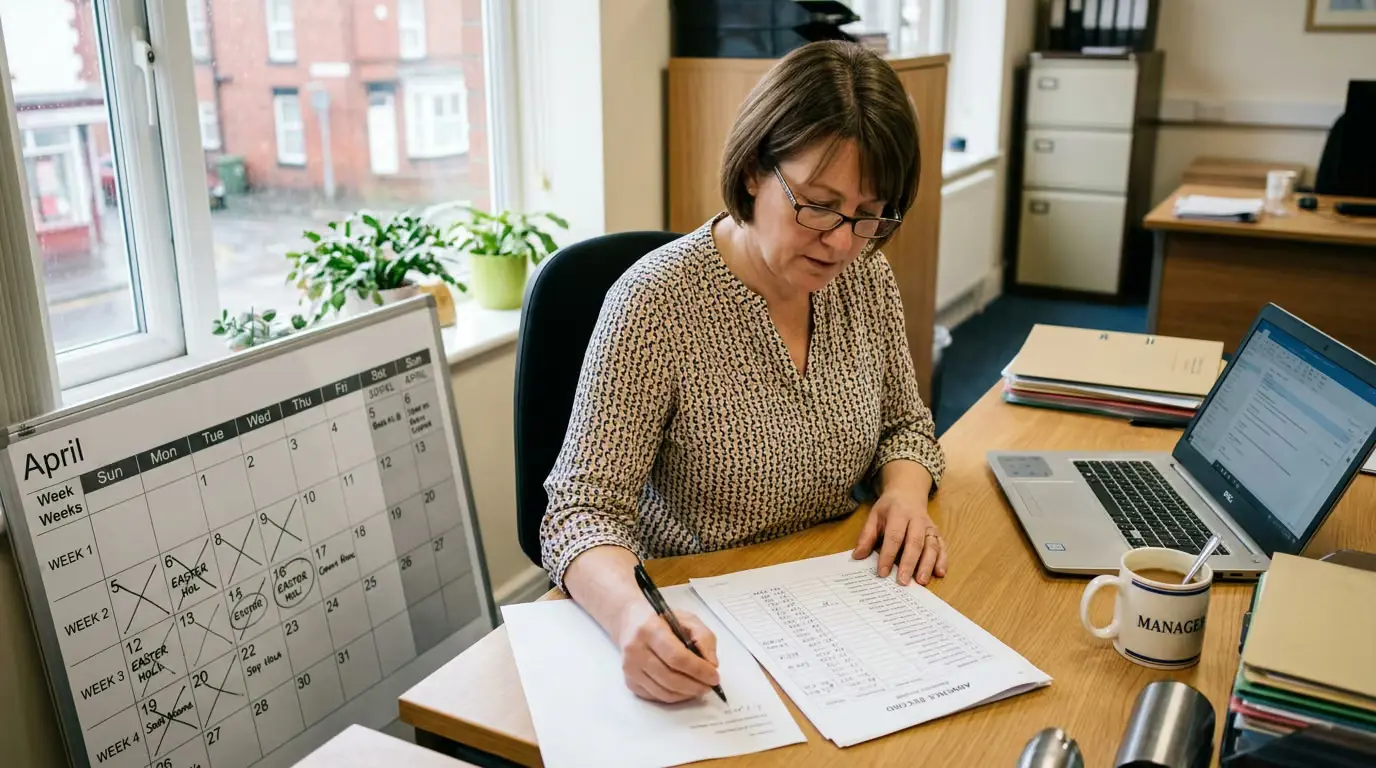
Documentary photograph, a UK office manager sitting at a desk reviewing a printed absence record and a calendar with weeks marked off, a laptop open beside a mug of coffee, soft natural window light on a weekday morning, palette of warm cream, oak, muted navy and brushed steel, the calendar and paperwork anchoring the lower-left two-thirds of the frame, shot on a Canon R6 at 50mm f/2.8, photojournalism, subtle film grain, no AI artefacts, no warped text, landscape orientation 16:9.