Yes. An employer must give a P60 to every employee who is still working for them on 5 April, and it must reach the employee by 31 May, on paper or electronically [1]. The duty sits in HMRC's own rules: by 31 May each year the employer issues a P60 to each employee employed at 5 April for whom a Full Payment Submission has been completed [2].
That makes the P60 one of the few payroll documents an employer is legally obliged to hand over without being asked. The certificate summarises a full tax year of pay, tax and National Insurance, and employees rely on it for tax returns, loan applications and proof of income [3].
This article sets out exactly when the duty applies, who qualifies, what counts as proper delivery, and the steps an employee can take if a P60 never arrives.
Key takeaways
- Providing a P60 is a legal duty, not a courtesy, for every employee employed on 5 April [2].
- The deadline is 31 May following the end of the tax year, and the form can be paper or electronic [1].
- An employee who left before 5 April does not get a P60; their record is the P45 [3].
- If an employer does not issue a P60, an employee can raise it directly, then escalate to HMRC, which can require the employer to comply [4].
The legal duty, in plain terms
The obligation is fixed by date, not by request. An employer must produce a P60 for each employee who was on the payroll on 5 April, the last day of the tax year, and deliver it by 31 May [1]. The employee does not have to ask for it, and the employer cannot decline to provide it [2].
The reason the duty is taken seriously is that the P60 is the year-end certificate of pay and tax, and HMRC names it as the document an employee uses to prove income for a loan or a mortgage, to reclaim overpaid tax, or to complete a Self Assessment return [3]. A reader weighing up how the certificate supports a property purchase can read the dedicated guide on using a P60 for a mortgage.
Who qualifies, and who does not
The test is simple but strict: the employee must be employed on 5 April. The table below sets out how the common situations fall.
| Situation on 5 April | P60 due? | What the person receives |
|---|---|---|
| Still employed | Yes | A P60 by 31 May [[1]](https://www.gov.uk/payroll-annual-reporting/give-employees-p60-form) |
| Left before 5 April | No | A P45 issued at leaving [[3]](https://www.gov.uk/paye-forms-p45-p60-p11d/p60) |
| On maternity or long-term sick leave but still employed | Yes | A P60 by 31 May [[1]](https://www.gov.uk/payroll-annual-reporting/give-employees-p60-form) |
| Multiple jobs | Yes, one per employment | A separate P60 from each employer [[5]](https://www.gov.uk/paye-forms-p45-p60-p11d) |
The point most often missed is that being absent does not remove the entitlement. An employee on maternity leave or long-term sickness who remains on the payroll on 5 April is still owed a P60. Conversely, an employer should not issue a P60 to anyone who had already left by 5 April, because their pay and tax for the year is captured on the P45 instead [3].
What counts as providing a P60
Delivery can be physical or digital. The form may be issued on paper or electronically, and a digital P60 is fully valid; where it is sent electronically it carries wording confirming it is a printed copy of an electronic P60 [1]. Many employees now receive theirs through the same portal that delivers their payslips, often in April once the final pay run of the year is processed [3].
The certificate is generated from figures the employer has already filed with HMRC in real time, so it is a step in the year-end cycle rather than a document compiled by hand [6]. Software holding the HMRC Recognised badge submits each Real Time Information return and produces every P60 automatically, which is why UK payroll software keeps the 31 May deadline routine even for an employer issuing payslips to a single director through an instant payslip service.
What an employee can do if no P60 arrives
The first step is to raise it with whoever runs the payroll, because most missing P60s are an oversight rather than a refusal. ACAS advises settling the matter with the employer first, and an employee can raise a formal grievance if an informal request does not work [4]. ACAS does not arbitrate on a missing P60 itself, but it points employees towards the right escalation [4].
Where an employer still does not comply, the matter can be reported to HMRC, which can contact the employer directly and require the document to be issued [4]. In the meantime, the figures behind the P60 are not out of reach: HMRC holds the same pay and tax data and a personal tax account shows it by employer for the current and previous five years [7]. For a formal record, HMRC issues a statement of employment history that most lenders and official bodies accept in place of the certificate [8].
If the original P60 was issued but has since been lost, the route differs. The employer reissues it as a copy marked 'Duplicate', and because employers keep PAYE records for at least three years after the relevant tax year, a recent duplicate is usually quick to obtain [9]. A fuller walkthrough of every route sits in the guide on how to get a P60.
The employer's side of the obligation
For the employer, meeting the duty is a matter of running year-end cleanly rather than chasing a separate task. Records have to be kept for at least three years after the tax year ends, which is also what makes duplicates straightforward later [10]. An employer whose system cannot produce P60s can order substitute forms from HMRC, though that is now a fallback rather than the norm [6].
Accountants issuing certificates across many client schemes run year-end from a payroll platform built for bureaux, and platforms that embed payroll into their own products generate every P60 programmatically through an HMRC-recognised payroll API. In each case the legal duty is met automatically, the same filing that satisfies HMRC produces the certificate the employee is owed.
What the employer has to issue
The legal duty is to provide this document, in this form, by 31 May. These are the four zones it has to carry.
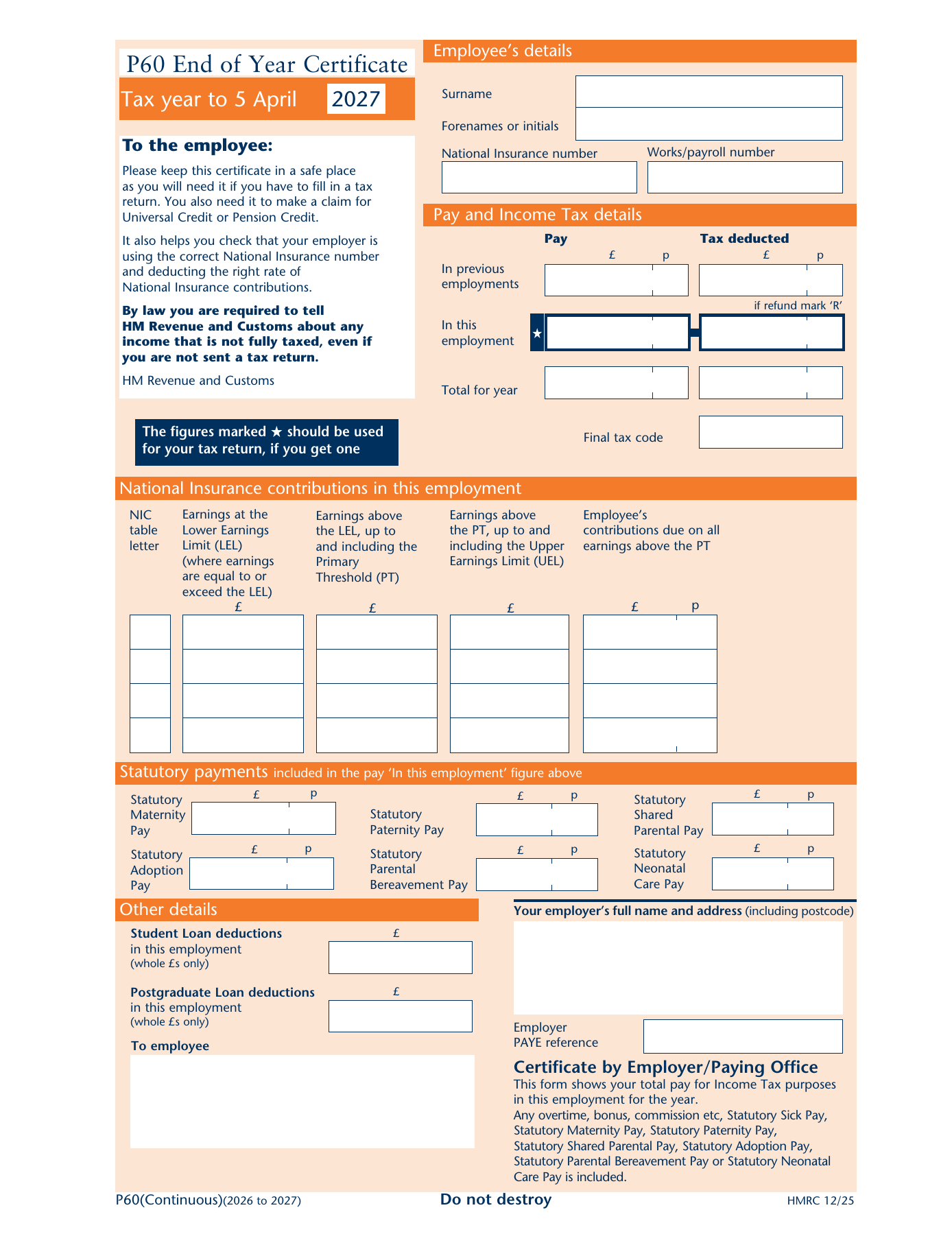
Employee details. Name, National Insurance number, works number and the tax code at the end of the year.
Pay and Income Tax. Pay and tax in this employment, plus anything carried in from a previous job in the same year.
National Insurance. Earnings by NI letter, split across the lower earnings limit, primary threshold and upper earnings limit.
Statutory payments. Maternity, paternity, adoption and shared parental pay, then the employer’s certificate.
Each zone is explained in detail, with a zoom on the form, in What is a P60?.
Conclusion
Providing a P60 is a clear legal duty: every employee on the payroll on 5 April must receive one by 31 May, whether on paper or electronically, and absence on leave does not remove the entitlement. An employee who left mid-year relies on the P45 instead, and where a P60 fails to arrive there is a defined path from a direct request to HMRC escalation.
As payroll data reaches HMRC in real time and personal tax accounts put the figures within easy reach, the practical risk of a missing P60 is shrinking. The duty remains, but the data behind it now offers a reliable backstop when the paper itself is delayed or lost.
Frequently asked questions
Is an employer legally required to provide a P60?
Yes. An employer must give a P60 to every employee who was still employed on 5 April, and it must be provided by 31 May following the end of the tax year. The duty applies automatically, so the employee does not need to request it. It can be delivered on paper or electronically, and a digital P60 is just as valid as a printed one.
Does someone who left their job during the year get a P60?
No. A P60 only goes to employees on the payroll on 5 April, the last day of the tax year. Anyone who left before that date receives a P45 covering their pay and tax up to the leaving date instead. If they started a new job before 5 April, the new employer's P60 includes the earlier figures from the P45.
What can an employee do if an employer refuses to provide a P60?
The first step is to raise it directly with the payroll team, and if that fails, to raise a formal grievance. ACAS advises resolving it with the employer where possible. If the employer still does not comply, the employee can report the matter to HMRC, which can contact the employer and require the P60 to be issued. While waiting, HMRC's own records can provide proof of the same pay and tax figures.
Does an employee on maternity or sick leave still get a P60?
Yes. The entitlement depends only on being on the payroll on 5 April, not on having worked recently. An employee on maternity leave or long-term sickness absence who remains employed on that date must still receive a P60 by 31 May, covering the pay and any statutory payments recorded during the tax year.
To see exactly what the certificate must contain, box by box, read our guide to what is a P60 or download the official HMRC P60 for 2026-27 (PDF).