
Every employee on a payroll on 5 April must receive a P60 by 31 May, and the form always comes from the employer, never from HMRC [1]. A replacement copy is allowed, but it has to be marked 'Duplicate', because the original is a once-a-year certificate of pay, Income Tax and National Insurance for a single employment [2].
Those two rules shape every answer to the question of how to get one. The route depends entirely on the situation: a current job, a job left part way through the year, a lost copy, or an employer that has closed down. Each has a clear path, and where the paper itself is unreachable, the figures behind it are not.
Key takeaways
- The employer issues the P60 automatically by 31 May; there is no form to fill in [1].
- Only an employee still on the payroll on 5 April gets a P60; a leaver relies on the P45 instead [3].
- A lost P60 is replaced by the employer as a copy marked 'Duplicate', not reissued as a fresh original [4].
- HMRC holds the same pay and tax data and releases it free as a statement of earnings, accepted in place of the certificate [5].
Where a P60 comes from
A P60 is not requested, it is delivered. At the end of the tax year the employer runs its final payroll report, then produces a P60 for every employee still working on 5 April, on paper or electronically [1]. The deadline to hand it over is 31 May, and the certificate covers the whole tax year for that one job [6].
HMRC sits behind the form but never in front of it. Employers report pay and tax in real time throughout the year, so HMRC holds the data, yet it does not generate the printed certificate and will not send one out [3]. The employer is the only source of the document itself.
Getting a P60 for a current job
For a current job, no action is usually needed. Most payroll software issues the P60 as soon as the final pay run of the year is processed, so many employees receive it in April, often through the same portal that carries their payslips [2]. An employee who has heard nothing by early June should ask whoever runs the payroll before assuming a problem [1].
If an employer simply fails to provide one, the first step is to raise it directly, and ACAS advises settling the matter with the employer before escalating [7]. ACAS does not arbitrate on missing P60s, but persistent non-issue can be reported to HMRC, which can press the employer to comply [7].
When the job ended during the year
An employee who left before 5 April gets no P60 from that job, because the certificate only goes to people on the payroll on the last day of the tax year [3]. The record for that part-year employment is the P45 issued at departure, and anyone who has mislaid theirs can follow the guide on how to get a P45.
Where the same person started a new job before the year ended, the figures are not lost. The new employer's P60 rolls in the earlier pay and tax from the P45, so a single certificate covers both employments for the year [8]. That is why handing the P45 to a new employer promptly matters: it keeps the year-end certificate complete.
Replacing a lost P60
A P60 that has gone missing is replaced by the employer who issued it, not by HMRC. The employer can supply a copy from its own records, which must be clearly marked 'Duplicate' to distinguish it from the original certificate [4]. Employers must keep PAYE records for at least three years after the end of the tax year they relate to, so a duplicate for a recent year is usually quick to obtain [9].
When the employer has closed down or cannot be reached, the certificate itself is beyond recovery, but the underlying figures sit with HMRC. The same data that fed the P60 is available through HMRC's online services, and the statements it produces are widely accepted in place of the form [5]. A full year-end checklist for employers is set out in the companion guide on how to get a P60.
What a P60 is actually needed for
Knowing why a P60 is wanted often points to a quicker alternative, because the certificate is rarely the only acceptable evidence. The table below sets out the common reasons and what else satisfies them.
| Situation | What the P60 supports | Common alternative |
|---|---|---|
| Mortgage application | Annual income for affordability checks [2] | Recent payslips, which many lenders prefer |
| Tax refund claim | Proof of tax paid in the year [12] | HMRC's own record of tax deducted |
| Self Assessment return | The employment pages of the return [11] | Figures pre-filled from PAYE data |
| Proof of income | Income for a tenancy or visa check [5] | A statement of earnings from HMRC |
For a refund or a Self Assessment return, the figures matter more than the paper, and HMRC's records carry the same numbers a P60 would [12]. Mortgage lenders increasingly want to see recent payslips that match money landing in an account, so a P60 is one document among several rather than the decisive one [2].
The employer's side of issuing a P60
For the employer, the P60 is a fixed step in the year-end cycle, produced from data already filed rather than typed up by hand [6]. Software holding the HMRC Recognised badge generates every certificate automatically, which is why UK payroll software makes the 31 May deadline a non-event even for a one-person company paying a single director.
An employer whose system cannot produce P60s can order blank forms from HMRC, though that is increasingly a fallback rather than a routine [8]. Bureaux issuing certificates across many client schemes run the year-end from a payroll platform built for accountants, and platforms that embed payroll into their own products generate P60s programmatically through an HMRC-recognised payroll API.
What you should be receiving
Whichever route it arrives by, the certificate looks the same. This is the official 2026-27 form, so you can check that what you have been sent is complete.
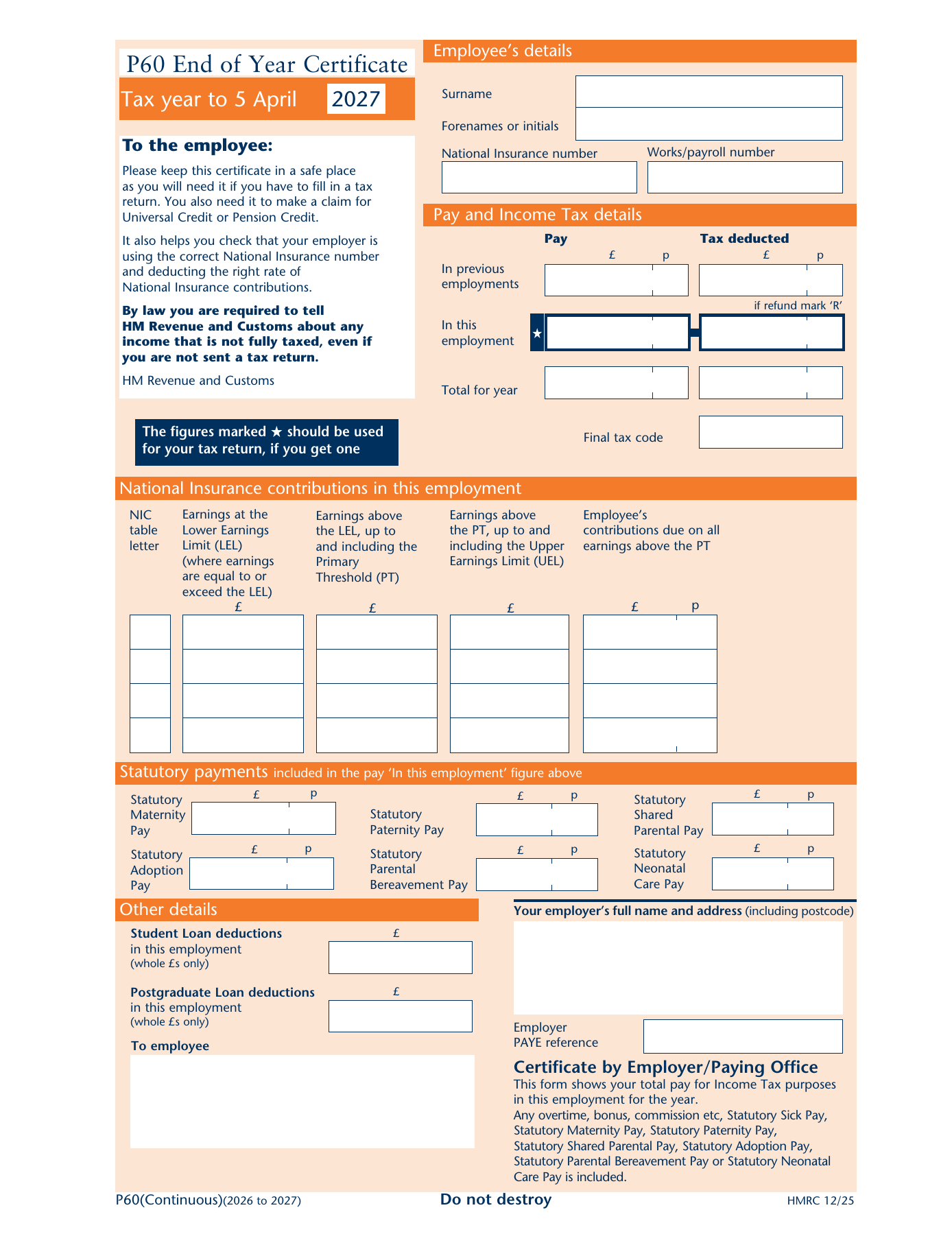
Employee details. Name, National Insurance number, works number and the tax code at the end of the year.
Pay and Income Tax. Pay and tax in this employment, plus anything carried in from a previous job in the same year.
National Insurance. Earnings by NI letter, split across the lower earnings limit, primary threshold and upper earnings limit.
Statutory payments. Maternity, paternity, adoption and shared parental pay, then the employer’s certificate.
Every figure is explained zone by zone, with a zoom on each, in What is a P60?.
Conclusion
Getting a P60 is really a question of which situation applies. A current employee waits for the employer to issue it by 31 May; a leaver looks to the P45 instead; a lost copy comes back as a duplicate from the employer that wrote it; and where the employer is gone, HMRC's records carry the same figures. No single missing document leaves anyone without proof of a year's pay and tax.
The direction of travel is towards the data rather than the certificate. As payroll figures reach HMRC in real time and statements of earnings sit a few clicks away, the P60 is becoming a convenient summary rather than the only record, and the situations where its absence causes real difficulty are narrowing.
Frequently asked questions
Can a P60 be obtained directly from HMRC?
No. HMRC does not produce or store P60 certificates, so it cannot send one. It does hold the pay and tax figures the form is based on, and an individual can download a statement of earnings through a personal tax account or request one in writing. That statement is not a P60, but it shows the same numbers and is accepted by most lenders and official bodies as proof of income.
Why has an employer not issued a P60 to someone who left mid-year?
Because a P60 only goes to employees still on the payroll on 5 April, the final day of the tax year. Anyone who left before that date receives a P45 covering their pay and tax up to the leaving date instead. If the person started a new job before 5 April, the new employer's P60 includes the earlier figures, so the year-end certificate still captures the whole year.
Is a duplicate P60 as valid as the original?
Yes, for practical purposes. An employer can reissue a lost P60 as a copy that must be marked 'Duplicate', and lenders, HMRC and other bodies treat it as proof of the same figures. The marking exists only to distinguish it from the single original certificate; it does not reduce the document's standing as evidence of pay and tax for the year.
How far back can a P60 or its figures be retrieved?
An employer keeps PAYE records for at least three years after the tax year ends, so a duplicate for a recent year is usually straightforward. For older years, or where the employer has closed, HMRC's personal tax account shows pay and tax for the current and previous five years, and a written request to HMRC can reach further back still. The figures, rather than the paper, are what survive.
Once you have it, our box-by-box P60 guide explains every figure, with the official HMRC form (PDF) for reference.