A P60 records pay and tax for a full tax year, 6 April to 5 April, and every employee still on a payroll on 5 April must receive one by 31 May [1]. It is the single document that proves a year's earnings in one page, which is why a mortgage lender almost always asks for it [2].
For an employed applicant, the P60 rarely travels alone. Lenders pair it with recent payslips to confirm that the annual figure on the certificate matches the money landing in a bank account month to month. Understanding what each document proves, and what stands in when one is missing, makes a mortgage application smoother.
This article sets out why a lender wants a P60, what it is checked against, the route for a self-employed applicant who has no P60, and how to proceed when the certificate has been lost or the employer has closed.
Key takeaways
- A P60 proves a full tax year of pay and tax in one page and is the standard income document for an employed mortgage applicant [1].
- Most lenders ask for the latest P60 alongside the three most recent payslips, so the annual figure can be cross-checked against monthly pay [3].
- A self-employed applicant uses an SA302 tax calculation and a tax year overview instead of a P60 [4].
- A lost P60 is replaced by the employer as a copy marked 'Duplicate', and HMRC's own records carry the same figures if the employer is gone [5].
Why a mortgage lender asks for a P60
A lender has to satisfy itself that a borrower can afford the loan, and the rules require firms to obtain evidence of the income a customer declares, of a type and over a period adequate to support it [6]. A P60 fits that requirement neatly, because it states gross pay and the tax deducted across an entire year in a form HMRC defines [1].
The certificate carries weight because it is generated from data the employer has already filed with HMRC in real time, not a figure typed up for the application [7]. That independence is what makes it a strong proof of income for a loan or a mortgage, the use case HMRC itself names for the form [2].
What the P60 is checked against
A P60 shows a year in summary, but a lender also wants to see that the income is current and steady. The usual request is the most recent P60 plus the last three months of payslips, so the annual total and the monthly pattern line up [3].
The table below sets out the common employed-applicant documents and what each one demonstrates.
| Document | What it proves | Typical period requested |
|---|---|---|
| P60 | Full-year pay and tax for one employment [[1]](https://www.gov.uk/paye-forms-p45-p60-p11d/p60) | The latest tax year |
| Payslips | Current pay, deductions and any variable elements | Most recent three months |
| Bank statements | That pay reaches the account as stated | Most recent three months |
| Employment contract | Salary where a P60 is not yet available | On request |
Variable pay complicates the picture. Base salary is often only part of the total, and bonuses, commission and overtime can count towards earnings where a lender sees consistency across time, which is one reason the P60 and payslips are read together rather than in isolation [6]. For employers, issuing accurate payslips every period is part of the same compliance discipline, and most UK payroll software produces them automatically alongside the year-end P60.
When there is no P60: the self-employed route
A sole trader or company director taking dividends does not receive a P60 for that income, because a P60 only covers PAYE employment [2]. The equivalent evidence is an SA302 tax calculation, the figure HMRC produces from a Self Assessment return, usually backed by a tax year overview confirming the tax position [4].
Lenders typically want SA302s for the last two tax years, sometimes three, to judge whether self-employed income is stable [8]. A director who pays themselves a small PAYE salary through their own company will hold both: a P60 for the salary and an SA302 for the dividends. Running that salary correctly matters, and a one-person company still has to issue itself a compliant P60 each year for the PAYE element to be evidenced.
Replacing a lost P60 for an application
A P60 that has gone missing is replaced by the employer that issued it, not by HMRC. The employer supplies a copy from its records, which must be marked 'Duplicate' to set it apart from the single original certificate [5]. Employers keep PAYE records for at least three years after the tax year they relate to, so a duplicate for a recent year is usually quick to produce [9].
When the employer has closed down, the paper itself is gone but the figures are not. The same data that fed the P60 is held by HMRC and can be reached through a personal tax account, which shows pay and tax by employer for the current and previous five years [10]. For older years, or a formal record, HMRC issues a statement of employment history that lenders and other bodies accept in place of the certificate [5]. A fuller walkthrough of every route sits in the guide on how to get a P60, and anyone whose part-year record rests on a P45 can follow the companion guide on getting a P45.
| Route | What it provides | Coverage |
|---|---|---|
| Personal tax account | Pay and tax by employer and year [[10]](https://www.gov.uk/personal-tax-account) | Current and previous 5 years |
| Statement of employment history | A formal record of pay and tax [[5]](https://www.gov.uk/get-proof-employment-history) | Any year, including older ones |
| Check Income Tax record | Pay and tax for the current year [[11]](https://www.gov.uk/check-income-tax-current-year) | The live tax year |
The employer's part in a clean P60
A lender's confidence in a P60 rests on the employer having reported the year accurately. The P60 is a fixed step in the year-end cycle, drawn from figures already filed rather than recompiled by hand [7]. Software holding the HMRC Recognised badge submits each Real Time Information return and generates every certificate automatically, which keeps the 31 May deadline routine even for a single-director scheme [3].
Accountants issuing certificates across many client schemes run year-end from a payroll platform built for bureaux, and platforms that embed payroll into their own products generate P60s programmatically through an HMRC-recognised payroll API. In each case the document a borrower hands to a lender traces back to a single accurate filing.
What the lender will be reading
An underwriter looks at two zones in particular: the pay figure for the year and the employer certificate that stands behind it. Here is where they sit on the official form.
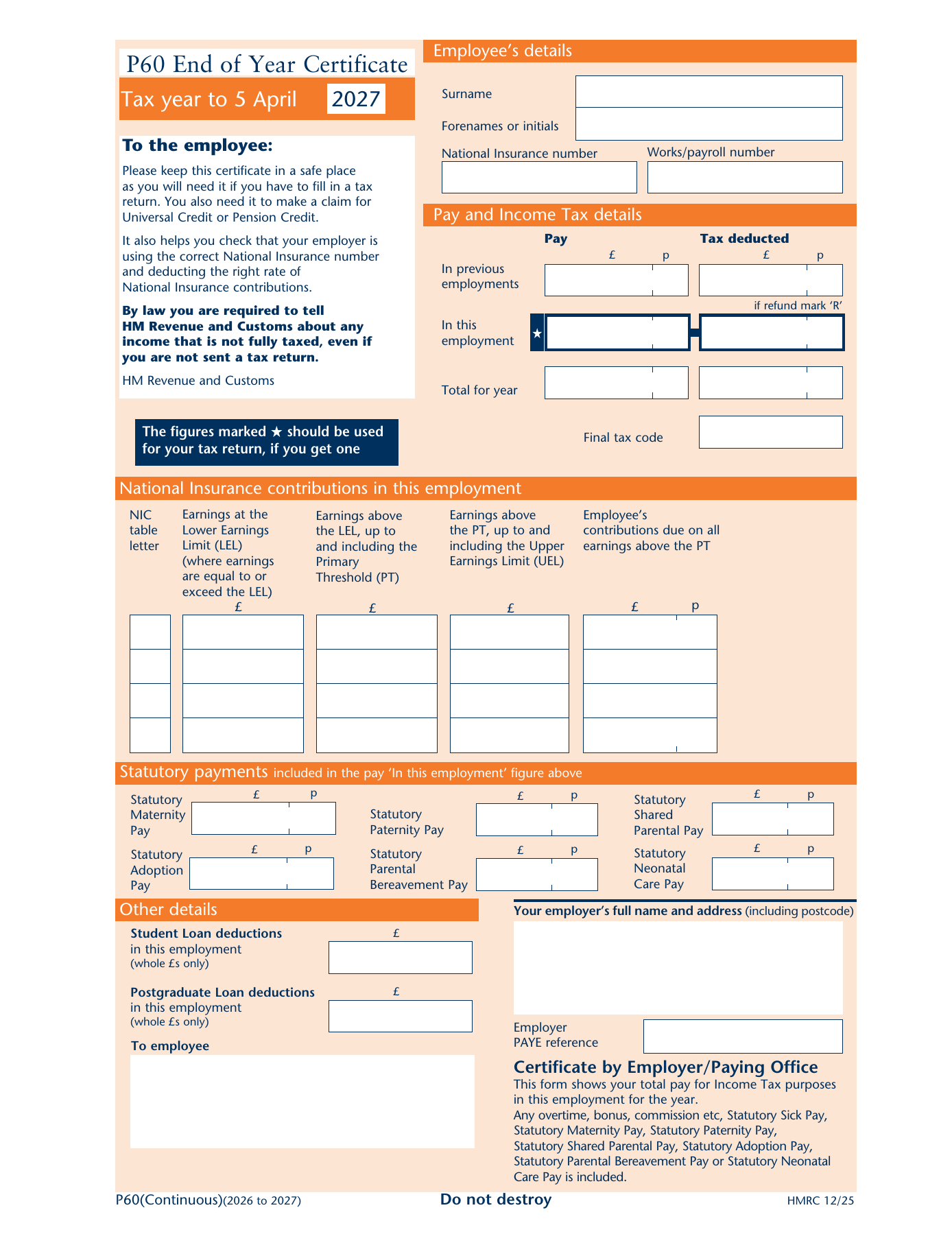
Employee details. Name, National Insurance number, works number and the tax code at the end of the year.
Pay and Income Tax. Pay and tax in this employment, plus anything carried in from a previous job in the same year.
National Insurance. Earnings by NI letter, split across the lower earnings limit, primary threshold and upper earnings limit.
Statutory payments. Maternity, paternity, adoption and shared parental pay, then the employer’s certificate.
Every figure on the certificate is explained zone by zone in What is a P60?.
Conclusion
For an employed applicant, the P60 is the backbone of the income evidence a mortgage lender wants, but it is read alongside payslips and bank statements rather than on its own. For a self-employed applicant, the SA302 and tax year overview play the same role, and a director may need both. Where the form has been lost, a duplicate from the employer or a statement from HMRC carries the same figures.
The direction of travel is towards the underlying data. As pay reaches HMRC in real time and personal tax accounts put the figures a few clicks away, the P60 is becoming one trusted summary among several, and a missing certificate is rarely the obstacle to a mortgage that it once was.
Frequently asked questions
Will a mortgage lender accept a P60 on its own as proof of income?
Rarely. A P60 proves a full year of pay and tax, but most lenders pair it with the three most recent payslips and bank statements so the annual figure can be checked against current monthly income. The combination shows both the historic total and that the pay is ongoing. A P60 alone, with no recent payslips, leaves a gap a lender usually wants filled.
What does a self-employed applicant use instead of a P60?
A self-employed applicant uses an SA302 tax calculation from their Self Assessment return, normally supported by a tax year overview that confirms the tax HMRC has recorded. Lenders generally want two years of SA302s, sometimes three, to judge whether the income is stable. A company director who takes a PAYE salary as well as dividends will usually hold a P60 for the salary and an SA302 for the rest.
How can someone get the figures from a P60 if the employer has closed down?
The certificate cannot be reissued by a closed employer, but the figures survive with HMRC. A personal tax account shows pay and tax by employer for the current and previous five years, and HMRC can provide a formal statement of employment history for older periods. Lenders and other bodies accept these records in place of the original P60.
Is a duplicate P60 acceptable for a mortgage application?
Yes. An employer can reissue a lost P60 as a copy that must be marked 'Duplicate', and lenders treat it as proof of the same pay and tax figures. The marking only distinguishes it from the single original certificate and does not reduce its standing as evidence of income for the year.
Lenders read specific boxes: the starred 'in this employment' pay figure and the final tax code. Our box-by-box P60 guide shows where each sits on the official form (PDF).