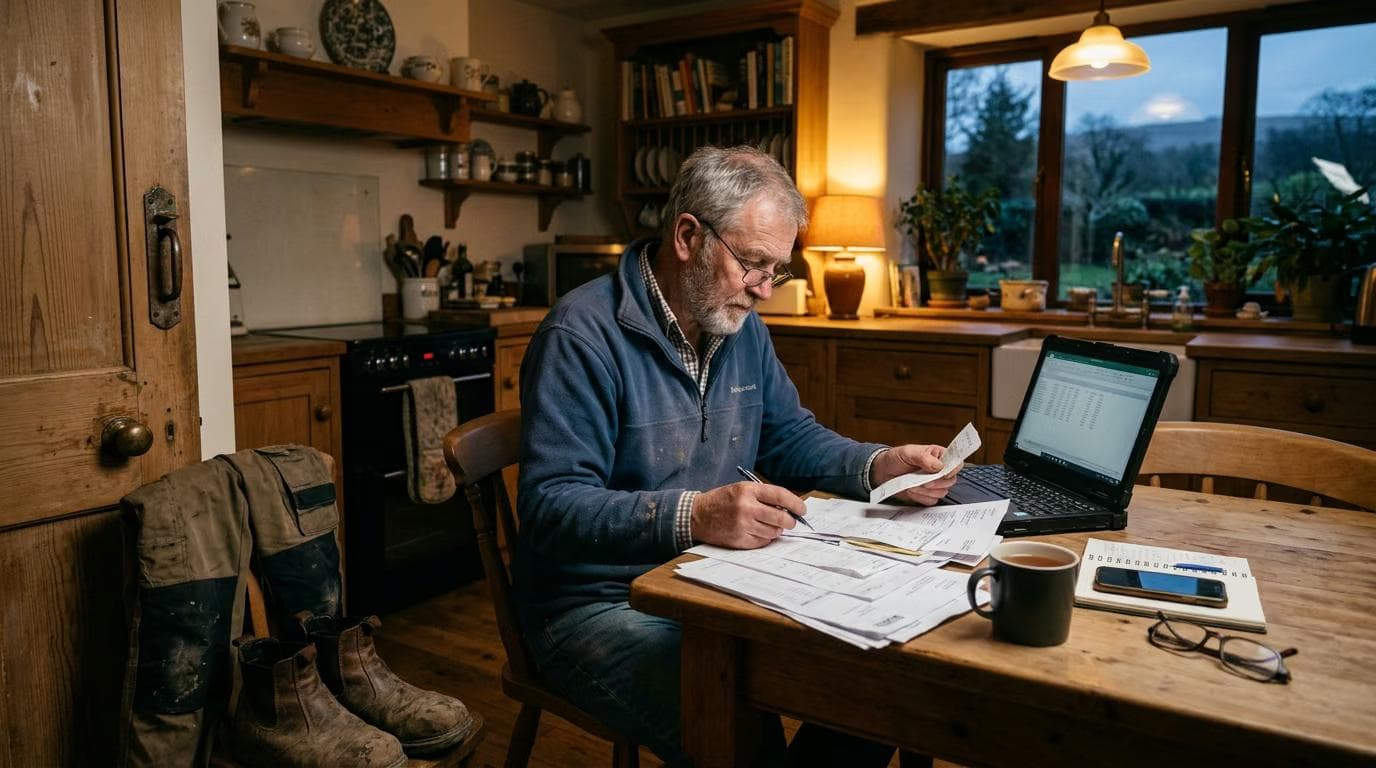
A self-employed subcontractor has 20% taken from every qualifying payment during the year, yet those deductions are only advance payments towards Income Tax and Class 4 National Insurance, not a final settlement [9]. Because tax deducted at source often exceeds the tax actually due once expenses are counted, many subcontractors finish the year owed a refund rather than facing a bill [1].
That refund only arrives if the subcontractor files. Registration under the Construction Industry Scheme does not remove the duty to complete a Self Assessment tax return, and the return is where the deductions taken by contractors are reconciled against the true liability [1]. File late and the refund is delayed while penalties for missing the deadline begin at £100 [3].
This article explains why a CIS subcontractor still files a tax return, where CIS deductions are reported on the Self Assessment pages, how allowable expenses reduce the bill, the deadlines and penalties that apply, and the two routes to reclaiming an overpayment.
Key takeaways
- CIS deductions of 20% (or 30% if unregistered) are advance payments towards Income Tax and Class 4 National Insurance, reconciled through the annual tax return.
- A self-employed subcontractor reports CIS income and deductions on the self-employment pages of the Self Assessment return (SA103S or SA103F).
- The online filing and payment deadline is 31 January, with a paper deadline of 31 October.
- Where deductions exceed the final liability, HMRC repays the excess, and an in-year claim is possible using form CIS40.
- Missing the 31 January deadline triggers a £100 penalty, followed by daily penalties after three months.
Why a CIS subcontractor still files a tax return
The Construction Industry Scheme collects tax during the year, but it does not calculate the final amount owed. A subcontractor remains responsible for paying the correct Income Tax and National Insurance on its profits, and the Self Assessment return is the instrument that settles the account [1]. HMRC works out the tax and National Insurance bill, subtracts the deductions contractors have already made, and either repays the excess or asks for a balancing payment where there is a shortfall [1].
The scheme therefore front-loads tax rather than finalising it. A subcontractor who has had deductions taken all year still has to declare its income, claim its costs, and let the return do the arithmetic [5].
Deductions are advance payments, not final tax
Each deduction a contractor makes is credited against the subcontractor's eventual liability, specifically its Income Tax and, for an individual, its Class 4 National Insurance [9]. The deduction is taken from the labour element of a payment, after materials, VAT, plant hire and certain other costs are stripped out, so it is calculated on a figure narrower than the full invoice [10].
Because the 20% rate is applied to gross labour before expenses, it frequently overshoots the real tax rate once business costs and the personal allowance are taken into account [1]. That is the structural reason so many subcontractors are due money back: tax has been withheld on turnover, but tax is charged on profit [5].
Who files what: sole trader, partnership, company
The return that carries CIS income depends on the business structure. A sole trader reports CIS income and deductions on the self-employment supplementary pages of the individual Self Assessment return, the SA103S short version or SA103F full version [1]. A partnership reports through the Partnership return, the SA800, with each partner also declaring their share on their own return [1].
A limited company subcontractor is the exception. It does not reclaim CIS through a Self Assessment return at all, but through its payroll scheme by offsetting deductions against the PAYE and National Insurance it owes as an employer [6]. Company directors running payroll for a small business manage that offset each month rather than waiting for an annual return.
Reporting CIS on the Self Assessment return
The self-employment pages are where a subcontractor turns a year of invoices and deduction statements into a single tax calculation. Getting the figures right depends on two things: entering the CIS deductions in the correct box so they are credited, and claiming every allowable expense so the taxable profit is not overstated [1].
The self-employment pages and the CIS deductions figure
On the self-employment pages, the subcontractor reports total turnover from construction work, then separately enters the total CIS deductions taken by contractors during the year as tax already paid [1]. HMRC treats that figure as a credit against the final Income Tax and Class 4 National Insurance bill, which is what produces a refund where the credit is larger than the liability [9].
The figure entered must match the payment and deduction statements the contractors issued, which is why keeping every statement matters [10]. A subcontractor cannot claim credit for a deduction it cannot evidence, so a missing statement can mean a smaller refund than the subcontractor is actually owed [5]. Where a subcontractor also issues one-off documents to others, an instant payslip generator produces clean, compliant records that make year-end reconciliation faster.
Materials, expenses and reducing the bill
Because tax is charged on profit, the expenses claimed on the return directly affect how large a refund is due. A self-employed subcontractor can deduct the everyday costs of running the business, including tools, materials, protective clothing, and travel such as fuel, public transport and parking [8]. Travel between home and a site can be claimed by a subcontractor who works at two or more sites during the year, though the rules on ordinary commuting are strict [8].
Larger tools and equipment with a working life beyond a couple of years are usually claimed through the Annual Investment Allowance rather than as a simple expense, and any private use must be excluded [8]. Materials already netted off by a contractor before deduction should not be double-counted, so a subcontractor separating labour and materials correctly on invoices keeps the return consistent with the deduction statements [10]. Anyone new to the mechanics can start with the Moonworkers guide to payroll for construction and CIS.
Deadlines, payments on account and penalties
The CIS subcontractor's return runs on the standard Self Assessment calendar, and both filing and payment carry fixed dates [2]. Missing them delays any refund and adds penalties and interest, so the deadlines are worth treating as immovable.
| Obligation | Deadline |
|---|---|
| Paper tax return | 31 October following the tax year |
| Online tax return | 31 January following the tax year |
| Balancing payment for the year | 31 January |
| First payment on account | 31 January |
| Second payment on account | 31 July |
Sources: filing deadlines from HMRC [2] and payments on account guidance [4].
Filing, payments on account and refunds
The online return and any balancing payment are both due by 31 January following the end of the tax year [2]. A subcontractor whose deductions cover the whole liability may have nothing to pay and a refund to collect, but the return must still be filed by the deadline to trigger it [1].
Payments on account complicate the picture for subcontractors whose deductions do not cover the bill. Where tax remains owing, HMRC asks for advance payments towards the next year, each normally half of the previous year's liability, due on 31 January and 31 July [4]. Because CIS deductions are credited first, a subcontractor with consistent 20% withholding often has modest or nil payments on account, but the position should be checked each year rather than assumed [4].
Late filing penalties
The Self Assessment penalty regime is automatic and escalates on a set timetable, independent of how much tax is owed [3]. A subcontractor due a refund can still be penalised for filing late, because the penalty attaches to the missed deadline, not the balance.
| Time after 31 January deadline | Penalty |
|---|---|
| Missed the deadline | £100 fixed |
| 3 months late | £10 per day, up to 90 days (maximum £900) |
| 6 months late | greater of £300 or 5% of the tax due |
| 12 months late | a further greater of £300 or 5% of the tax due |
Sources: penalty structure from HMRC's Self Assessment penalties guidance [3].
A subcontractor with a reasonable excuse can appeal a penalty, and any penalty that stands must be paid within 30 days of the assessment notice [3]. The simplest defence is to file on time, because the daily penalties in particular can add up quickly once a return is more than three months overdue [3].
Claiming a CIS refund
Where deductions exceed the tax and National Insurance due, the subcontractor is owed the difference, and there are two routes to recover it depending on timing [1]. Most subcontractors reclaim through the annual return, but an in-year route exists for those who cannot wait.
After the tax year, through the return
The standard route is the Self Assessment return itself. Once the return is filed, HMRC offsets the CIS deductions against the liability and repays any excess, and a subcontractor who has already received a CIS repayment during the year includes it in the box for tax refunded or set off so the calculation stays accurate [1]. Filing early in the tax year, from 6 April, brings the refund forward for subcontractors who are consistently overpaid [2].
For accountants handling several construction clients, batching these returns early is a practical way to get refunds to clients sooner, and a payroll bureau platform helps keep each client's records straight through the year so the return is quick to assemble [5].
In-year claims with form CIS40
A subcontractor who makes little or no profit and whose deductions already exceed the likely liability does not always have to wait until after the tax year ends. A self-employed individual can claim an in-year repayment of excess deductions using online form CIS40, and a partnership uses form CIS41 for deductions attributable to the partnership [7].
HMRC reviews the subcontractor's wider tax position before releasing an in-year repayment, and expects the taxpayer's affairs to be up to date [11]. The in-year route is particularly useful where subcontract income has ceased partway through the year, because it avoids leaving an overpayment tied up until the next filing season [7]. After the tax year has ended, the return replaces the form as the proper mechanism [7].
Getting the figures right
A CIS tax return is only as accurate as the records behind it, and the subcontractors who reclaim the right amount are those who keep every payment and deduction statement and every expense receipt through the year [10]. Reconciling contractor statements against bank receipts as they arrive, rather than in a January rush, keeps the CIS deductions figure defensible and the expenses complete [1].
For subcontractors who also employ others, the picture involves both an annual Self Assessment return and a running payroll obligation for staff. HMRC-recognised payroll software for sole traders and small firms keeps the employment side compliant with Real Time Information, while the subcontractor's own CIS income flows through the Self Assessment return. Software platforms building tools for the trades can embed the same compliance logic through an HMRC-recognised payroll API, so their construction users handle PAYE and CIS inside one product.
Conclusion
A CIS tax return is where a year of tax withheld at source is finally measured against the tax actually owed, and for most subcontractors that reconciliation ends in a repayment rather than a bill. The deductions are a prepayment, the expenses shrink the taxable profit, and the return turns the two into a single figure that HMRC either refunds or, less often, tops up.
The subcontractors who benefit most are those who file early and keep clean records, because the refund lands sooner and the risk of a penalty disappears. As construction administration moves towards more automated, integrated compliance, the annual return becomes less of a scramble and more a confirmation of figures already reconciled month by month, with the overpaid tax returned without delay.
Frequently asked questions
Do CIS subcontractors have to file a Self Assessment tax return?
Yes. A self-employed subcontractor must file a Self Assessment return each year even though contractors deduct tax at source, because those deductions are only advance payments and the return settles the final liability [1]. CIS income and deductions go on the self-employment pages, the SA103S or SA103F. A limited company subcontractor is different and reclaims through its payroll scheme rather than a Self Assessment return [6].
Why do CIS subcontractors often get a tax refund?
CIS deductions are taken at 20% of gross labour, but tax is charged only on profit after allowable expenses and the personal allowance [9]. Because turnover is taxed at source while profit is what is actually liable, the deductions frequently exceed the final bill, and HMRC repays the difference once the return is filed [1]. Claiming every legitimate expense increases the refund by lowering the taxable profit [8].
When is the CIS tax return deadline?
The deadlines follow the standard Self Assessment calendar: 31 October for a paper return and 31 January for an online return, with any balancing payment also due by 31 January [2]. A subcontractor due a refund should still file by the deadline, because the £100 late-filing penalty applies regardless of whether tax is owed [3]. Filing soon after the tax year opens on 6 April brings any refund forward.
Can a subcontractor claim a CIS refund before the tax year ends?
Yes, in limited circumstances. A self-employed subcontractor whose deductions already exceed the likely liability can claim an in-year repayment using online form CIS40, or CIS41 for a partnership share [7]. HMRC checks that the subcontractor's tax affairs are up to date before repaying, and the route is most useful where subcontract income has stopped mid-year [11]. After the tax year ends, the annual return is used instead.
Image prompt: A wide realistic landscape photograph of a self-employed builder at a kitchen table in the evening, sorting paper invoices and receipts beside a laptop and a mug of tea, warm domestic lighting, work boots by the door, muted natural colours, documentary style, shallow depth of field, no text, no logos, shot on a 35mm lens.