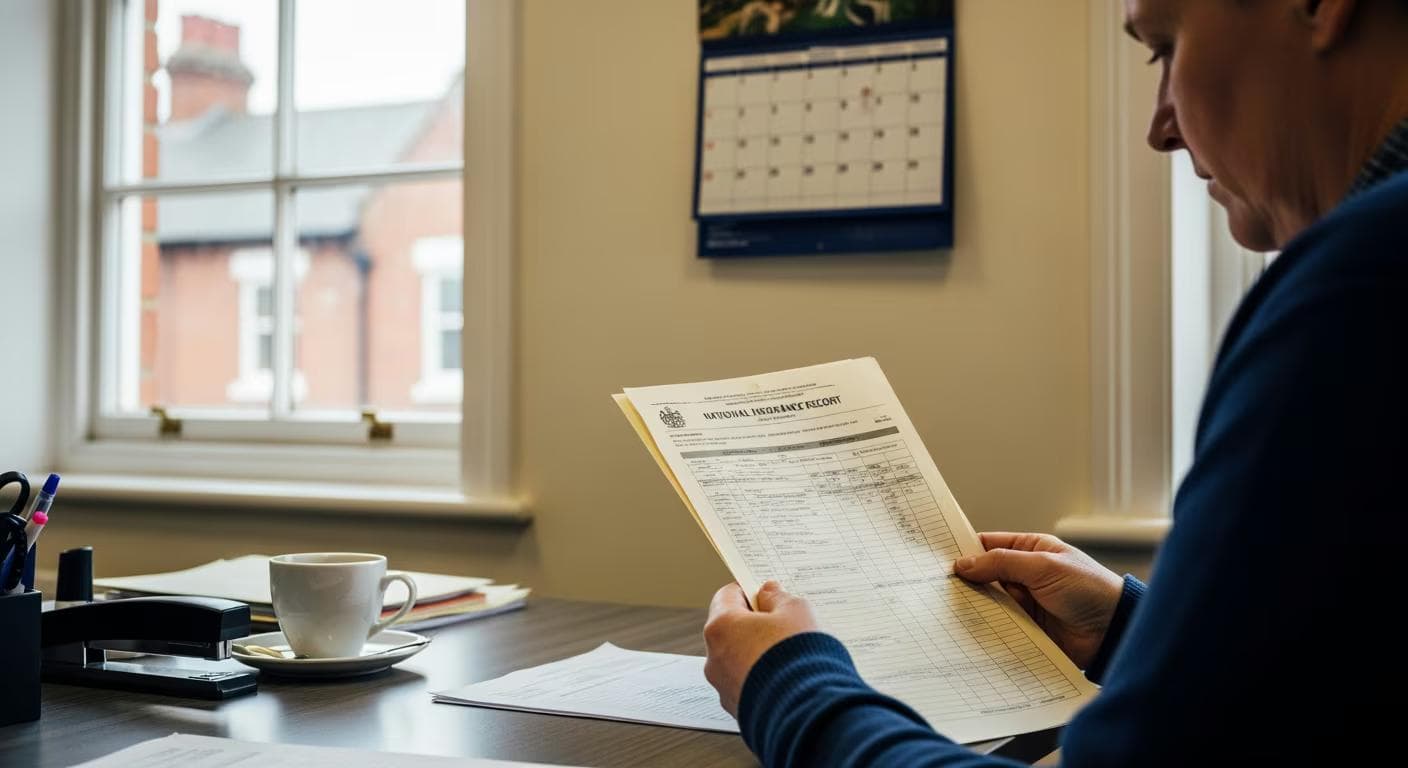
Approximately 35 qualifying years of National Insurance contributions are required for the full new State Pension of £241.30 a week in the 2026-27 tax year [1]. National Insurance credits fill gaps in that record for periods when a person is not paying NI directly, including time spent unemployed, caring for a child or dependent, or receiving certain benefits. Credits are not contributions but they count in exactly the same way toward the qualifying year total.
Employers and payroll practitioners working with employees who return from parental leave, long-term sickness, or periods of unemployment need to understand how credits interact with the employee's NI record. An employee who has received credits during a gap may return to payroll with a complete qualifying year already secured, even without making a single NI payment in that period.
Key takeaways
- National Insurance credits count toward qualifying years for the State Pension on the same basis as paid contributions, without the employee paying NI [2].
- Two types exist: Class 1 credits (count toward the State Pension and certain contributory benefits) and Class 3 credits (count toward the State Pension only).
- Some credits are applied automatically; others require a formal application.
- Universal Credit recipients receive Class 3 credits automatically [3].
- Employees and self-employed people should check their NI record at least every few years to catch any credits not applied correctly.
What National Insurance credits are
A National Insurance credit is a week credited to an individual's NI record that counts toward benefit entitlement without a payment being made [2]. Credits exist because the qualifying-year framework would otherwise penalise people for time spent caring for dependants, recovering from illness, or actively seeking work.
HMRC recognises two categories of credit [4]:
| Credit type | What it counts toward |
|---|---|
| Class 1 credits | State Pension and certain contributory benefits (New Style JSA, New Style ESA) |
| Class 3 credits | State Pension only |
Class 1 credits carry broader value. A claimant who receives Class 1 credits during unemployment preserves not only their pension record but also their eligibility for contribution-based New Style Jobseeker's Allowance and New Style Employment and Support Allowance in future periods of need [5].
Class 3 credits are narrower but still significant. Universal Credit claimants, for example, receive Class 3 credits automatically throughout their claim [3]. Over several years, those credits can constitute a large share of the 35 qualifying years needed for a full State Pension.
Who qualifies for NI credits
Eligibility splits into two groups: those whose credits are applied automatically because they claim a qualifying benefit, and those who must actively apply.
Automatic NI credits
The following groups receive NI credits without any application being needed [3]:
| Circumstance | Credit type | Notes |
|---|---|---|
| Receiving Universal Credit | Class 3 | Applied automatically throughout the claim period |
| Receiving Carer's Allowance | Class 1 | One credit for each week of entitlement |
| New Style JSA claimant | Class 1 | Applied while actively seeking work and available |
| New Style ESA claimant | Class 1 | Applied during the period of incapacity for work |
| Child Benefit claimant for a child under 12 | Class 3 | Applied to the Child Benefit claimant's record |
| Incapacity Benefit or Severe Disablement Allowance | Class 1 | Applies for the duration of the claim |
The Child Benefit route deserves particular attention in a payroll context. A parent claiming Child Benefit for a child under 12 receives Class 3 credits automatically for each week of the claim [3]. An employee returning from maternity or adoption leave may already hold credits from the weeks before they resumed PAYE contributions.
Credits that require an application
Not all credits flow automatically. The following situations require the individual to apply to HMRC directly [3]:
| Circumstance | Credit type | How to apply |
|---|---|---|
| Carer's Credit (20+ hours/week of qualifying care) | Class 3 | Apply via form CF411A or online [[6]](https://www.gov.uk/government/publications/national-insurance-credits-for-parents-and-carers-cf411a) |
| Specified Adult Childcare credits (eligible family member caring for a grandchild under 12) | Class 3 | Apply via gov.uk/guidance/apply-for-specified-adult-childcare-credits [[7]](https://www.gov.uk/guidance/apply-for-specified-adult-childcare-credits) |
| Foster carer or kinship carer | Class 3 | Apply online or by post to HMRC |
| Jury service (non-self-employed) | Class 1 | Write to HMRC with the dates of service |
| Registered foster parent | Class 3 | Apply via form CF411A [[6]](https://www.gov.uk/government/publications/national-insurance-credits-for-parents-and-carers-cf411a) |
Carer's Credit in detail
Carer's Credit is available to individuals who provide 20 hours or more a week of care to a person receiving a qualifying disability benefit [3]. The carer must be over 16 and below State Pension age. Credits are Class 3 and count toward the State Pension only, not toward contributory benefit eligibility.
This route matters for employees who step back from work to provide care. An employee on unpaid carer's leave who qualifies for Carer's Credit can preserve their pension record for the duration of that leave without making any NI payment [2].
Specified Adult Childcare credits
Where a grandparent or other eligible family member cares for a grandchild under 12 so the parent can work, the parent's Child Benefit entitlement can be transferred as Class 3 credits to the carer [7]. The child's parent or main carer must countersign the application form. Applications cannot be submitted until 31 October in the year after the tax year claimed, as HMRC must first confirm the parent already has a qualifying year of their own.
Payroll teams at multi-client payroll bureaux sometimes encounter this when an employee's NI record shows unexpected credits from a prior tax year, reflecting the administrative lag in processing Specified Adult Childcare applications.
Credits and the State Pension calculation
Each qualifying year, whether from paid NI, credits, or voluntary contributions, adds approximately one thirty-fifth of the full State Pension rate. In the 2026-27 tax year, the full new State Pension is £241.30 a week [1]. A single qualifying year therefore adds roughly £6.89 a week (£358 a year) to a person's eventual State Pension.
A minimum of 10 qualifying years is required to receive any new State Pension at all. For employees who have spent significant time outside the labour market, credits may make the difference between qualifying and not [1].
Employees cannot check their NI record through the payroll system. The record is held by HMRC and accessed via the personal tax account at gov.uk/check-national-insurance-record. Employers who use HMRC-recognised payroll software submit Real Time Information payroll returns that update employee records in HMRC's systems; credits, however, are applied through entirely separate HMRC processes.
What employers and payroll teams should know
Employers are not responsible for ensuring employees claim the NI credits they are entitled to. The obligation to apply, where a claim is not automatic, rests with the individual. However, payroll teams are often the first point of contact when an employee queries their NI record, particularly after periods of long-term sick leave or parental leave [8].
An employee returning after a year of unpaid parental leave may ask whether that period affected their NI record. If they were receiving Universal Credit or Child Benefit during the leave, Class 3 credits will have been applied automatically. If not, they may need to apply for Carer's Credit or check whether any other credit route applies.
Payroll bureaux managing employers across multiple sectors can encounter this frequently. Multi-client payroll platforms that support documentation workflows make it straightforward to flag the correct advice to the employee without requiring manual tracking. The HMRC-recognised payroll API that underpins UK payroll software handles RTI submissions but does not interact with the credits system directly; credits sit in a separate HMRC administration stream.
Conclusion
National Insurance credits are a material part of the UK's social security architecture, protecting State Pension entitlement for millions of people who cannot make paid contributions in a given year. The distinction between Class 1 and Class 3 credits determines whether they also count toward contributory benefit eligibility, not just the pension. Employers and payroll practitioners should be able to explain the basic routes to credits when employees raise questions, even if the application itself lies outside the payroll system.
As more employees move between employment, self-employment, and caring responsibilities over their careers, understanding how credits interact with paid NI contributions becomes more important for anyone managing their State Pension forecast.
Frequently asked questions
Do NI credits count the same as paid National Insurance contributions toward the State Pension?
Yes. Each week of NI credits counts toward the qualifying year total on the same basis as a week of paid Class 1 or Class 2 NI [2]. A qualifying year built entirely from Class 3 credits counts the same as a qualifying year built from employee NI payments. The 35-year requirement for a full new State Pension of £241.30 a week can be met through any combination of paid NI, credits, and voluntary contributions [1].
Who gets NI credits automatically without needing to apply?
Universal Credit recipients receive Class 3 credits automatically throughout their claim [3]. Child Benefit claimants for children under 12 also receive Class 3 credits automatically. Carer's Allowance recipients receive Class 1 credits automatically. Claimants of New Style JSA or New Style ESA also receive Class 1 credits during the benefit period. Credits for Carer's Credit, Specified Adult Childcare, and foster care require a formal application.
Can an employee on unpaid leave receive NI credits?
An employee on unpaid leave does not receive Class 1 NI contributions through PAYE, as no earnings are being paid. Whether credits apply depends on the individual's circumstances [2]. If they are receiving Universal Credit or Child Benefit during the leave, credits will be applied automatically. If not, they may be eligible for Carer's Credit or another credit route, but they must apply separately to HMRC. The employer's payroll system does not interact with the credits process.
What is the difference between NI credits and voluntary NI contributions?
NI credits are weeks added to the NI record by HMRC based on a qualifying circumstance, with no payment required from the individual [2]. Voluntary Class 3 contributions are payments made by the individual, currently £18.40 a week for the 2026-27 tax year [9], specifically to fill gaps in the NI record that credits have not covered. Both count as qualifying years. Credits are free; voluntary contributions carry a cost.