
A P60 is issued by an employer or a pension provider, never by HMRC, and it must reach everyone still on the payroll on 5 April by 31 May at the latest [1]. Anyone holding more than one job at year end receives a separate P60 from each employer, so two jobs means two certificates [2]. How to get one depends almost entirely on the kind of work and the kind of payer behind it.
The form is automatic for anyone taxed under PAYE who is still in post on the last day of the tax year. The variations that trip people up are the edge cases: a director paying their own salary, a pensioner, an umbrella or agency worker, a leaver, and a sole trader who gets nothing at all. Each has a clear answer.
Key takeaways
- A P60 is automatic for anyone on a PAYE payroll on 5 April; there is no form to request [1].
- More than one job at year end means more than one P60, one from each employer [2].
- A leaver before 5 April gets a P45 from that job, not a P60 [3].
- Sole traders get no P60 at all; their year-end record is the Self Assessment tax calculation [4].
Who is entitled to a P60
Entitlement turns on a single test: being on a PAYE payroll on 5 April, the last day of the tax year [2]. That test catches full-time and part-time employees, directors paid through PAYE, and pensioners whose pension provider deducts tax [1]. It excludes anyone who left before that date, who instead receives a P45 covering the part-year [3]. The table below sets out the common situations.
| Situation on 5 April | Year-end document | Issued by |
|---|---|---|
| Employed, one job | One P60 | The employer [1] |
| Employed, two or more jobs | One P60 per job | Each employer [2] |
| Director paid via PAYE | One P60 | The company's payroll [1] |
| Receiving a taxed pension | One P60 | The pension provider [2] |
| Left the job before 5 April | A P45, not a P60 | The former employer [3] |
| Sole trader, self-employed | Neither | Self Assessment record [4] |
Getting a P60 as a current employee
For a current employee, the certificate has usually already been produced and the only question is the delivery channel. Most modern payroll runs the P60 automatically from the final pay submission of the year and publishes it within days of 5 April, often through the same portal that carries the monthly payslips [2]. Software holding the HMRC Recognised badge generates every certificate as a routine part of year-end, so UK payroll software makes the 31 May deadline a non-event for the business [9].
An employee who has heard nothing by early June should ask whoever runs the payroll where the document was published before assuming anything has gone wrong, and a step-by-step on locating it sits in the guide on how to find a P60 [1].
Getting a P60 with more than one job or a pension
Two PAYE jobs at year end produce two P60s, each covering only the pay and tax from that employer, and a pension counts as a separate source in exactly the same way [2]. A pension provider that deducts tax has the same legal duty as an employer to issue a P60 by 31 May [1].
Where a job changed during the year and the P45 from the earlier job was handed to the new employer, the figures from both jobs are combined on the later employer's P60, so a single certificate reflects the whole year for that continuous PAYE record [3]. Handing the P45 over promptly is what keeps the year-end certificate complete.
Why a sole trader does not get one
A sole trader receives no P60, because the form is a record of tax collected through an employer's PAYE scheme and a sole trader has no employer [4]. The equivalent year-end record is the Self Assessment tax calculation, which sets out income and tax for the year and serves the same evidence role a P60 plays for an employee [10].
A director who pays themselves a salary through their own company is in a different position, because they are an employee of that company for PAYE purposes and the company's payroll must issue them a P60 [1]. A one-person company running an occasional payroll can produce the certificate, and related paperwork, with an instant payslip generator rather than a full bureau setup.
Getting the figures when the employer cannot
When an employer or pension provider has closed, or simply cannot be reached, the document is out of reach but the figures are not. HMRC holds the same pay and tax data from the payer's real-time submissions and releases it free through the personal tax account [6]. For a formal record, HMRC issues a statement of earnings setting out pay and tax for the period requested, and that statement is accepted in place of a P60 by lenders and other bodies [7].
A lost P60 from a payer that still exists is replaced by that payer, supplied as a copy marked 'Duplicate', since HMRC does not reissue the form itself [5]. Employers must keep PAYE records for at least three years after the tax year ends, so a recent duplicate is usually quick to obtain [12].
What a P60 is needed for
Knowing why a P60 is wanted often points to a faster route, because the certificate is rarely the only acceptable evidence. The table below sets out the usual reasons and the common alternative.
| Reason | What the P60 supports | Common alternative |
|---|---|---|
| Mortgage or loan application | Annual income for affordability checks [2] | Recent payslips, which many lenders prefer |
| Tax refund claim | Proof of tax paid in the year [6] | HMRC's own record of tax deducted |
| Self Assessment return | The employment figures on the return [10] | Figures pre-filled from PAYE data |
| Proof of income for a tenancy or visa | Verified annual earnings [7] | A statement of earnings from HMRC |
For a refund or a Self Assessment return, the figures matter more than the paper, and HMRC's records carry the same numbers [6]. Accountants handling Self Assessment alongside payroll for many clients keep all of this in one place through a multi-client payroll dashboard [9].
When a P60 has not arrived by 31 May
If a P60 is not in hand by 31 May, the payer is in breach of its duty, so the first step is to chase the employer or pension provider directly [1]. ACAS advises settling the matter with the employer before escalating, and a persistent failure to issue the form can be reported to HMRC, which can press the payer and correct the individual's tax record from its own data [8]. The data behind the missing form is always retrievable from the personal tax account in the meantime [6].
Checking the certificate is complete
Whatever your employment type, the certificate carries the same four zones. Use this to check nothing is missing from the copy you were given.
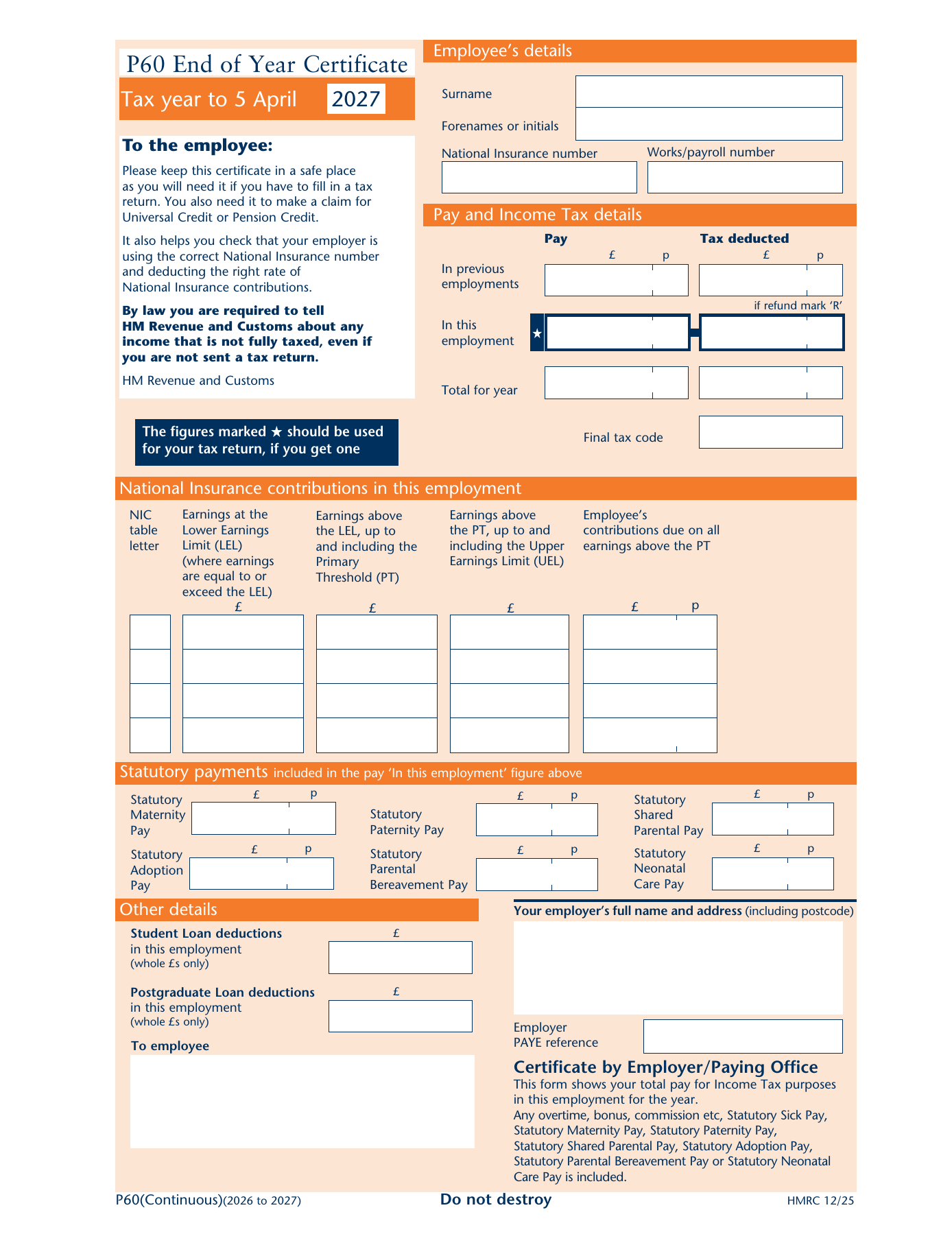
Employee details. Name, National Insurance number, works number and the tax code at the end of the year.
Pay and Income Tax. Pay and tax in this employment, plus anything carried in from a previous job in the same year.
National Insurance. Earnings by NI letter, split across the lower earnings limit, primary threshold and upper earnings limit.
Statutory payments. Maternity, paternity, adoption and shared parental pay, then the employer’s certificate.
Every figure on it is explained zone by zone in What is a P60?.
Conclusion
Getting a P60 comes down to one question, who the payer is, because the certificate always flows from the employer or pension provider that ran the PAYE, never from HMRC. Once the payer is identified, every situation has a clear path: a current job means checking the portal, multiple jobs mean multiple certificates, a director issues their own, and a sole trader looks to Self Assessment instead.
The form itself is becoming less of a bottleneck as payroll moves into portals and apps, but the underlying duty has not changed. Every PAYE payer must still produce a P60 by 31 May, and where the document slips through the cracks, the figures behind it remain a few clicks away in HMRC's own records.
Frequently asked questions
Can a P60 be requested from HMRC directly?
No. HMRC does not issue the P60 document, because the form is the duty of the employer or pension provider that ran the PAYE [3]. HMRC can, however, supply the same pay and tax figures free through the personal tax account or a statement of earnings, both accepted in place of the certificate for most purposes [7].
Does a company director get a P60?
A director who takes a salary through their own company's PAYE scheme is an employee for that purpose, so the company's payroll must issue them a P60 by 31 May [1]. A director who takes only dividends and no salary has no PAYE pay to certify, so no P60 is produced, and the dividends are reported through Self Assessment instead [10].
How many P60s does someone with two jobs get?
One from each employer they were working for on 5 April, so two jobs produce two P60s [2]. Each certificate covers only the pay and tax from that single employment, and the figures are not combined across the two unless one job followed the other on the same continuous PAYE record [3].
What does an umbrella or agency worker do for a P60?
A worker paid through an umbrella company or agency under PAYE is entitled to a P60 from that umbrella or agency, which has the same 31 May duty as any other employer [1]. The certificate comes from the payer that deducted the tax, so the request goes to the umbrella or agency rather than the end client where the work was carried out [2].
Every box on the certificate is explained in our P60 guide, alongside the official HMRC form (PDF).