
Work out holiday entitlement and pay
Rolled-up holiday pay and the 52-week average for irregular hours workers, per the statutory rules.
Every worker in the UK is entitled to 5.6 weeks of paid holiday a year [1]. For salaried staff that is a simple calculation. For hourly paid, casual and zero-hours workers it is anything but: hours change from week to week, pay changes with them, and since April 2024 the law has offered two distinct ways of paying for that leave. Get the method wrong and you are either underpaying staff, which creates a legal liability, or overpaying them, which quietly erodes your margins.
Our free holiday pay calculator below handles both methods: rolled-up holiday pay at 12.07%, and the 52-week average used when an irregular hours worker actually takes leave. Enter the hours and pay, and it applies the same rounding rules HMRC and GOV.UK describe. The rest of this guide explains what the calculator is doing, with worked examples you can check by hand.
A 12.07% uplift on total pay, added to every payslip instead of paying when leave is taken.
Annual entitlement: 5.6 weeks (12.07%) · change
Statutory minimum is 5.6 weeks. Enter more if the contract gives extra leave.
Rolled-up holiday pay
£0.00
Enter hours and hourly rate, then press Calculate.
Tired of maintaining pay data by hand?
Moonworkers tracks hours, accrual and holiday pay automatically for every casual worker, itemised on each payslip and reported to HMRC in real time.
Key takeaways
- All workers accrue 5.6 weeks of paid holiday a year, capped at 28 days. Hourly paid staff with irregular hours accrue it at 12.07% of hours worked in each pay period.
- There are two lawful payment methods for irregular hours workers: rolled-up holiday pay (a 12.07% uplift paid each payday) and the 52-week average (paid when leave is taken).
- Rolled-up holiday pay must be itemised separately on the payslip and paid at the same time as the work it relates to.
- The 52-week average only counts weeks in which the worker was actually paid, looking back up to 104 weeks to find them.
- Holiday pay sits on top of National Minimum Wage obligations: from April 2026 the main rate is £12.71 an hour for workers aged 21 and over.
How holiday entitlement works for hourly paid staff
The statutory minimum of 5.6 weeks applies to every worker from their first day of employment, whether they are full time, part time, on a zero-hours contract or working through an agency [1]. For someone working a regular five-day week, 5.6 weeks translates neatly into 28 days. The entitlement is capped there: a worker on a six-day week still gets a maximum of 28 days.
The difficulty with hourly paid staff is that a week of leave has no fixed value. A bartender who worked 32 hours one week and 12 the next does not have an obvious answer to the question of what a week off should pay. That is why the rules for this group were rewritten, and why the calculation now runs on hours and percentages rather than days.
One point that surprises many employers: there is no separate statutory right to bank holidays [2]. You can include them within the 5.6 weeks or grant them on top; the contract decides. For hourly paid staff who work variable rotas, most employers simply fold bank holidays into the accrued entitlement.
The rules for irregular hours and part-year workers
For leave years starting on or after 1 April 2024, the Working Time Regulations define two categories with their own regime [3]. An irregular hours worker is someone whose paid hours in each pay period are wholly or mostly variable under their contract: zero-hours staff and most casual workers fit here. A part-year worker is someone whose contract only requires them to work part of the year, with unpaid periods in between, such as term-time staff.
For both groups, holiday entitlement accrues at 12.07% of the hours worked in each pay period. The figure is not arbitrary. A year contains 52 weeks; take away the 5.6 weeks of statutory holiday and 46.4 working weeks remain. Divide 5.6 by 46.4 and you get 12.07%. In other words, for every hour worked, a worker earns about 7 minutes and 15 seconds of paid leave.
The accrued figure is rounded to the nearest whole hour, with half hours rounding up. Someone who works 130 hours in a month accrues 15.69 hours, which becomes 16 hours of leave. GOV.UK's own entitlement calculator applies the same convention [4], and so does ours.
Method 1: the 52-week average
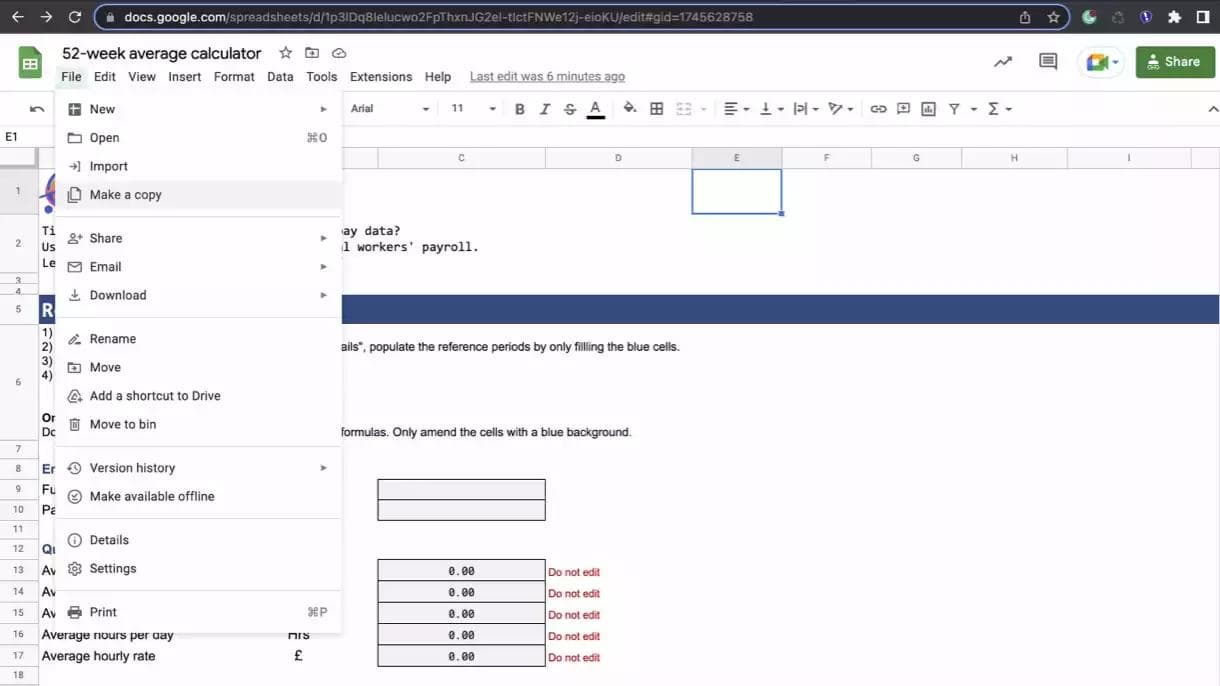
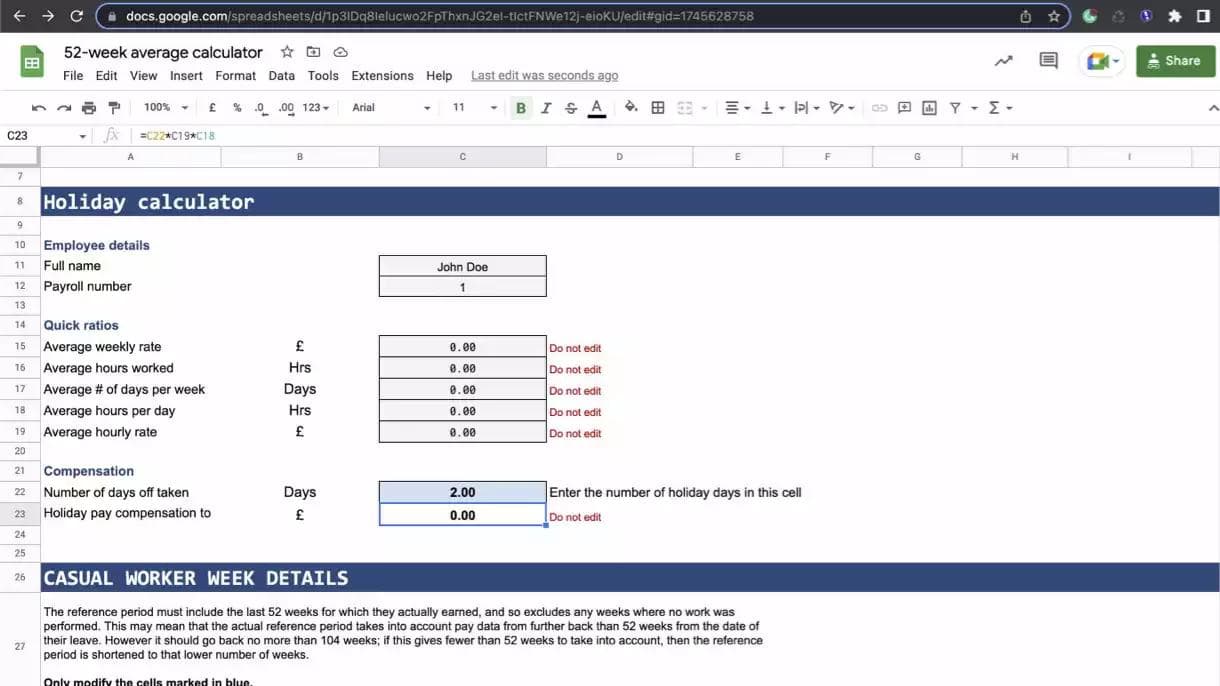
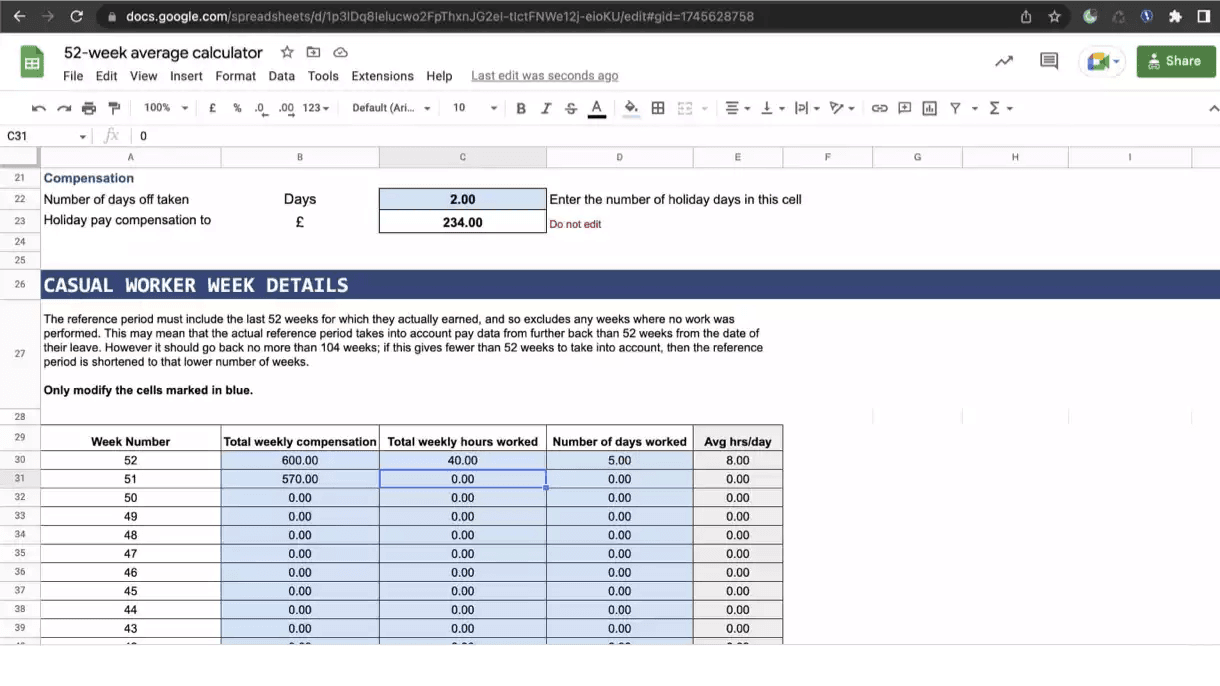
When an hourly paid worker takes a week of accrued leave, the default way to price it is the 52-week average [5]. You look back over the last 52 weeks in which the worker was actually paid, add up the gross pay for those weeks, and divide by 52. Weeks with no pay at all are skipped, and you can reach back up to 104 weeks to assemble the 52 paid weeks. If the worker has fewer than 52 paid weeks of history, you average over what exists.
Two details catch employers out. First, the average is based on pay for work, including regular overtime and commission, not just the basic hourly rate. Second, the reference period moves: each new holiday recalculates the average from the most recent paid weeks, so a worker whose hours have grown recently takes their holiday at the newer, higher average.
The arithmetic is simple but the bookkeeping is not, because you need 52 weeks of clean pay history per worker. We cover the record-keeping side in detail in our guide to calculating the 52-week average for casual workers. The calculator on this page has a week-by-week mode where you can paste in up to 52 weeks of gross pay and hours and get the average instantly.
Method 2: rolled-up holiday pay
Rolled-up holiday pay was outlawed for years, then explicitly re-legalised for irregular hours and part-year workers whose leave years begin on or after 1 April 2024 [3]. Instead of paying for holiday when it is taken, you add an uplift of 12.07% to the worker's total pay in every pay period. The worker still takes time off; it is simply unpaid at the moment they take it, because the pay has already been spread across the year.
The conditions are strict. The uplift must be calculated on total pay in the period, shown as a separate line on the payslip, and paid at the same time as the wages for the work. Burying it inside the hourly rate does not count and leaves you exposed to back-pay claims. If a worker never takes their leave, you must still encourage them to do so: rolled-up pay settles the money, not the right to rest.
The calculation itself, as applied by our calculator: divide the period's gross pay by 100, round to the penny, multiply by 12.07, and round to the penny again. On £1,240 of gross pay that gives £12.40 times 12.07, which is £149.67 of holiday pay for the period.
Rolled-up or 52-week average: which should you use?
Rolled-up holiday pay wins on administration. There is no reference period to maintain, no recalculation when leave is booked, and the cost lands in the same period as the revenue that funded it, which makes forecasting easier for seasonal businesses. Its weakness is behavioural: because time off is unpaid at the point it is taken, some workers skip holiday altogether, and tribunals expect you to have nudged them to rest.
The 52-week average preserves the traditional experience of a paid week off, which many workers prefer, and it smooths out seasonal spikes in earnings. In exchange you carry the record-keeping burden, and a worker whose recent weeks were unusually busy will cost more per week of leave than their average hourly rate suggests.
Whichever you choose, apply it consistently for the leave year and write it into the contract. Payroll software that understands both methods, like Moonworkers, will itemise rolled-up pay on the payslip automatically and keep the 52-week history for you.
Worked examples with real numbers
Example 1: zero-hours bar staff on rolled-up pay
Amira works behind a bar on a zero-hours contract at £12.71 an hour. In June she works 96 hours, earning £1,220.16. Her employer uses rolled-up holiday pay: £1,220.16 divided by 100 is £12.20 to the penny, multiplied by 12.07 gives £147.25. Her June payslip shows £1,220.16 of wages plus a separate line of £147.25 holiday pay, £1,367.41 gross in total. She also accrues the time itself: 96 hours times 12.07% is 11.59, rounded to 12 hours of leave she can book as unpaid time off.
Example 2: a week off priced with the 52-week average
Dan is a warehouse picker whose weekly gross pay over the last 14 months ranged from £180 to £420. His employer pays holiday when it is taken. When Dan books a week off, payroll takes his last 52 paid weeks, which requires reaching back 56 calendar weeks because four weeks had no work at all. The 52 paid weeks total £15,600, so the average is £300, and his week of leave pays £300 gross. Six months later, after a busy autumn, the same exercise produces £327: the reference period has rolled forward.
Example 3: accrual over a quarter
A seasonal cafe takes on Priya for the summer. Across 13 weekly pay periods she works 412 hours. Her accrued leave is 412 times 12.07%, which is 49.73, rounded to 50 hours. If her average hourly earnings over her paid weeks are £13.10, a full week off at her usual 30 hours would be priced at £393 under the 52-week method, averaged over however many paid weeks she has, or her employer could have rolled up 12.07% on each of the 13 payslips instead.
Holiday pay and the National Minimum Wage
Holiday pay is calculated on actual earnings, so minimum wage compliance feeds straight into it. From 1 April 2026 the National Living Wage is £12.71 an hour for workers aged 21 and over, £10.85 for 18 to 20 year olds, and £8.00 for under-18s and apprentices [6]. If a worker's base rate is at the legal floor, their holiday pay cannot quietly dip below it, and a rolled-up uplift does not count towards minimum wage pay for the hours worked. You can check any hourly rate against the current thresholds with our minimum wage calculator.
Five mistakes that lead to underpayment claims
The same errors come up again and again when holiday pay disputes reach ACAS or a tribunal. Rolling holiday pay into the hourly rate without itemising it is the classic one: a rate advertised as including holiday pay settles nothing unless the payslip separates the two amounts. Basing the 52-week average on basic pay only, and ignoring regular overtime or commission, is the second. The third is counting unpaid weeks in the average, which drags it down and underpays the worker. The fourth is applying 12.07% to workers with fixed hours, who are outside the scheme and keep their normal entitlement. And the fifth is forgetting that entitlement accrues from day one, including during probation and notice periods.
Frequently asked questions
Does the 12.07% method apply to all hourly paid staff?
No. It applies to irregular hours workers and part-year workers as defined in the regulations. An hourly paid employee who works a fixed 20 hours every week has regular hours and accrues leave the traditional way, as a proportion of 5.6 weeks.
What happens to accrued holiday when a casual worker leaves?
Any accrued but untaken leave must be paid in the final payslip, priced at the 52-week average. If holiday pay was rolled up throughout, there is normally nothing left to pay because the money went out with each payslip, which is one reason seasonal employers favour the method.
Can I switch between the two methods?
Switch at the boundary of a leave year, not mid-year. Running both methods in the same year for the same worker invites double payment or gaps, and makes the payslip trail very hard to defend.
Is holiday pay taxable?
Yes. Holiday pay, rolled up or not, is ordinary earnings: it goes through PAYE and attracts income tax, National Insurance and pension contributions in the usual way.
Try the calculator, then automate it
The calculator above answers the pay question. If your question is about days and hours of entitlement rather than money, including starters, leavers and bank holidays by nation, use our holiday entitlement calculator instead, and see our companion guide on the rules of holiday pay for casual workers.
And when the spreadsheet stops scaling, Moonworkers payroll applies the 12.07% accrual, the rolled-up uplift and the 52-week average automatically, itemises everything on HMRC-compliant payslips and files your RTI submissions. Holiday pay for variable-hours teams stops being a monthly research project.
![How to Calculate Holiday Pay: Expert Guide for UK Employers [2025 Rules]](/_next/image?url=https%3A%2F%2Fcdn.sanity.io%2Fimages%2Fsgximu0h%2Fproduction%2Fad9df871db79fcf455e6697fd2a6403fa7426e55-1300x742.webp&w=3840&q=75)